Web Services v4.0.5
Ramesh Rangaiah, Navistar
Pejavar Rao, Navistar
Andrew Selletta, ADP
Hector Rivas, PACCAR
William Fitzpatrick, NADA
Copyright © 2011 Standards for Technology in Automotive Retail
| Revision History | |
|---|---|
| Revision 3.0s001 | December 2008 |
| |
| Revision 4.0g002 | May 2009 |
| |
| March 2010 | |
| |
| March 2011 | |
| |
Table of Contents
- I. Preface
- Part I. STAR Level One
- Part II. STAR Level Two
- STAR Interoperability Rules
- A. STAR Level One Check List
- Normative References
- Non-Normative References
List of Figures
- 2.1. Message Structure
- 2.2. Manifest
- 2.3. Process Message
- 2.4. ProcessMessage with Errors
- 2.5. ProcessMessage with Application System Errors
- 2.6. Successful PutMessage Sequence
- 2.7. PullMessage Structure
- 2.8. Successful PullMessage Operation
- 2.9. Payload Manifest
- 3.1. One-way Asynchronous Communication
- 3.2. Two-way Asynchronous Communication
- 4.1. PullMessage Filter Type
- 4.2. Generic Transport
- 4.3. Generic Payload Element Definition
- 4.4. Generic Element
- 5.1. WSDL Directory Structure
- 5.2. BOD Specific Service and Operations
- 5.3. BOD Specific Process Message Definition
- 5.4. BOD specific strongly typed payload
- 6.1. Spectrum of Error Types by Communication Mechanism
- 8.1. Example of Certificate Signed by Third Party CA
- 8.2. Example of Certificate Signed by Private CA
- 8.3. Example of Self-Signed Certificate
- 8.4. Example of Self-Signed Certificate Imported
- 9.1. Reliable Messaging Conversation Sequence
List of Tables
List of Examples
- 2.1. Sample STAR Web Service Message
- 2.2. SOAP Body Message
- 2.3. SOAP Message
- 2.4. SOAP Message with Filter
- 4.1. Sample Generic Message
- 6.1. Sample SOAP Fault
- 7.1. Sample of WS-Security
- 7.2. WS-Security Username and Passoword
- 7.3. Username Element
- 7.4. Dealer Number
- 7.5. Unique ID that Identifies Dealer
- 7.6. Combination Dealer Number and ID
- 7.7. Plain Text Password
- 7.8. Password Digest
- 8.1. WS-I Basic Security Profile Conformance Claim
- 9.1. Reliable Messaging Create Sequence
- 9.2. Reliable Messaging Header Acknowledgements
- 9.3. Reliable Messaging Header Message Sequence Number
- 10.1. Sample Message with Attachment
- 10.2. WSDL MTOM Encoding
- 10.3. MTOM encoded attachment
- 10.4. STAR MTOM encoded Attachment Element
The purpose of this document is to provide specifications and implementation guidelines for the STAR Web Service components.
This document is broken into the following sections for easier navigation:
Preface - Overview of the specifications and background
Introduction - Background and general document overview
Part I - STAR Level 1
Interface Specifications
Communication Patterns
Reliable Messaging
Error Handling
Security
Part II - STAR Level 2 (Still in development)
WS-Addressing
WS-ReliableMessaging
Attachments - MTOM
Security
Applying Policy
This document covers the STAR Web Services interfaces specifications including the WSDL, message packaging, web methods, and different communication patterns. It also covers the STAR Web Services security specifications, based on OASIS WS-Security 1.0. This document does not address Identity, Authentication, Privacy, Content Integrity, Non-Repudiation and Trusted Timestamps. Versioning, Policy and Reliable messaging are also covered.
The following items have been defined as out of scope:
Non-repudiation will be discussed under Auditing in a future release of these guidelines.
Authorization, Trust Models and Attack Prevention are out of the scope for this release of the STAR Transport Guidelines and may be discussed in future releases of this guideline.
Intermediaries, message routing, and other approaches to enhance or optimize the communication are also out of the scope of this document.
![[Note]](images/note.png) | Note |
|---|---|
This document is still under development. STAR Level 1 requirements have been added, but additional changes maybe necessary. The namespace will not change as additional requirements are added. This document is expected to stabalize during the latter half of 2009. |
This document is intended for application developers and application architects developing STAR Web Services interfaces.
Web Services provide a standard means of interoperating between different software applications, running on a variety of platforms. Interoperability is achieved by using standard communication protocols that are platform neutral such as HTTP and XML to transport messages through the Internet. SOAP, Simple Object Access Protocol, is the main specification that describes how messages should be packaged in XML format. SOAP was submitted to the W3C in 2000 by IBM, Microsoft, UserLand, and Developmentor. Other specifications work hand-in-hand with SOAP to provide complementary features such as WSDL (Web Service Description Language) to describe the interfaces and their bindings to communication protocols. And, UDDI (Universal Detection Discovery and Integration) to provide a registry service for service providers.
WS-I.org is the organization taking the responsibility of ensuring interoperability between the different Web Services implementations. In 2006, the organization published the WS-I Basic Profile 1.1, and this is the version that STAR is basing its web services guidelines on. The Basic Profile is based on the SOAP 1.1 specifications and describes SOAP bindings for HTTP only at this time. Bindings to other protocols such as TCP and SMTP are starting to emerge and might be included in a future version of the specifications.
In order for a service provider to be able to receive and process requests and send responses back it must satisfy the following high level requirements detailed in other guidelines documents:
Must have a fixed URL or IP address that is publicly accessible on the Internet.
Must have the server software and infrastructure required to parse and process incoming messages.
Security infrastructure to protect the publicly accessible servers as defined by Dealer Infrastructure guidelines or corporate security policy.
Must have queuing facility to queue response messages if immediate delivery to the client is not possible (either disconnected client or a communication problem).
STAR defines eight security requirements:
Business Authentication
Party Authentication
Privacy/Confidentiality
Source and Target Authentication
Source Only Authentication
System Authentication
Unique Party Identification
This section provides and overview of the different communication patterns described in this document. For more detailed description, please refer to Communication Patterns chapter in the document.
Synchronous vs. Asynchronous
Synchronous communication refers to sending a message to a service provider and receiving a response within a short timeout period (recommended timeout is 100 seconds) on the same connection. A synchronous method invocation of a web service maps to one HTTP request/response cycle and it is similar to the way web pages are requested using a browser.
Synchronous method invocations are used when a response needs to be received immediately, say, to display it to a user in an interactive transaction.
Asynchronous communication, on the other hand, refers to sending a message without waiting for a response. A response is sent in a separate communication back to the originator. The response might be generated after a few seconds, a few hours, or even a few days depending on the business rules.
Synchronous communication, due to its nature, adds more requirements on both the server and the client than asynchronous communication. The server MUST process the received message and return a response within the preset time window, or return an error message.
One-Way vs. Two-Way
In compliance with the WS-I Basic Profile 1.1, STAR currently uses HTTP as the underlying transport protocol for Web Services. And, thus, follows the same request-based model. In a request-based model, the client always initiates the communication and the server always sends the responses on the same TCP connection to the IP address from which the request originated. This model works well with web services and especially with low-end clients that do not have a fixed IP address or the infrastructure to support inbound requests.
In a one-way, request-based communication model, only the service provider is required to have a fixed IP address and the necessary hardware and software to listen to incoming messages. The client, on the other hand, can be very simple and can use any type of Internet connection, even those that do not provide a static IP address.
Due to its low requirements on the client end, the request-based model is suitable for dealer-to-OEM communication.
To achieve a two-way communication model, the original one-way model is duplicated in reverse: the client exposes the same set of web services and becomes a service provider too. This way, both sides are clients and service providers at the same time and they both can initiate requests to the other side. Based on business requirements and the agreement between the two parties, the client might chose not to implement the full set of functionality as the server to keep the implementation simple.
This section describes the necessary components and pieces that all STAR Level 1 compliant implementations must implement.
Table of Contents
The specifications define a set of methods and data types to facilitate exchanging synchronous and asynchronous messages using one-way or two-way communication models. This section describes these types and methods and explains how and where they apply.
This version of the specifications uses the following XML namespace to identify its types, methods and schemas:
http://www.starstandards.org/webservices/2009/transport
STAR supports two styles of WSDL.
Generic Transport - This transport can handle any type of payload. It is up to the implementer to determine the type of payload being sent and received and act accordingly. One end point is used to process all transport requests.
BOD Specific- This transport follows in line with the more traditional web service, as it expects a specific type of payload to be sent and a specific type to be returned. Multiple end points are needed to handle different types of BODS.
The type selected will depend on the requirements of the implementer. Some may choose to implement one or the other, and some may choose to implement both. A generic outfacing transport and possibly an internal BOD Specific transport to handle internal communications.
In order to ensure that the BOD Specific Web Service and the Generic Transport WSDL can exchange STAR BODs and interoperate, the SOAP Envelope and content must adhere to the same structure. The following items MUST match exactly:
Element and attribute names in the Soap Envelope MUST match.
The structure of the SOAP Message being sent MUST match.
The STAR Manifest and STAR Payload MUST match.
Where the items appear within the Soap Envelope MUST match.
Occurrence constraints MUST match between the WSDLs. If something is required in one it must be required in the other
If a field is optional in one it MUST be optional in the other
![[Important]](images/important.png) | STAR Level 1 Requirement |
|---|---|
STAR1015: STAR BOD Specific and Generic Transports MUST be message level interoperable. |
As long as the message produced by the WSDL is the same between both services, the styles can communicate with each other.To help keep these aligned, STAR uses an XSLT Style Sheet to generate the sample STAR Transport 2009 and BOD Specific WSDL templates included with the STAR Schema Repository. If changes are made to the manifest or payload these will automatically appear in both the Generic and the BOD Specific WSDLs.
The WS-I profiles define standards for interoperability that make it easier to ensure that web services and clients can work together across varied platforms and implementations. STAR web services MUST conform to the WS-I Basic Profile 1.1 for interoperability and include conformance claims in the WSDL. [ConformanceClaim]
| STAR Level 1 Requirement |
|---|---|
STAR1001: All web services must be compliant to the rules and specifications outlined by the WS-I Basic Profile. STAR1002: Appropriate compliance markers are required as specified by the WS-I Conformance Claim Attachment Mechanisms document. |
Table of Contents
Regardless of whether a Generic Transport or a BOD Specific transport is being implemented, the overall message packaging will be the same. As was discussed earlier, the two transport mechanisms have to be inter operable at the messaging level. The following sections describe the message architecture that applies to both transport methods.
The STAR Web Services transport was designed to provide a platform for secure and reliable delivery of any type of content in a standardized manner. The chosen architecture neither precludes nor requires attachments outside the body of the SOAP message for transportation of content. The chosen packaging methodology is well supported by all major Web Services toolkits and infrastructures and meets STAR's transport requirements.
The STAR Payload schema defines a package structure that provides additional features such as a standard way of packaging multiple contents (STAR BODs, XML documents, binary data, etc) in one payload and a message manifest that describes the contents of a message The figure below shows the structure of a valid STAR Web Services message
The first element under the SOAP:Body is the web method name. Three methods are defined: ProcessMessage, PutMessage, and PullMessage. Within the method element is the payload element, the primary element that encapsulates all transported payloads. The payload element contains one or more content elements, each of which encapsulates one and only one content element, such as a STAR BOD. The payload and content elements provide a standard format for transporting one or more XML documents inside the SOAP Body.
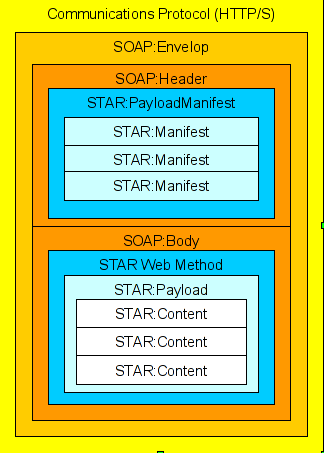
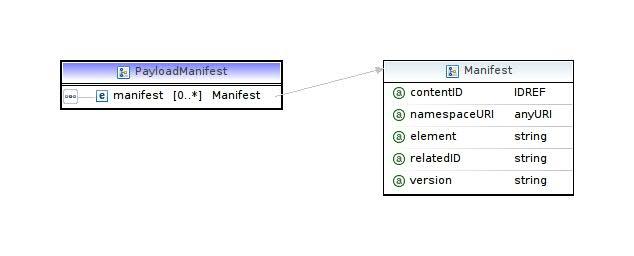
In the SOAP:Header, STAR defines a payloadManifest element, which contains one or more manifest elements. Each manifest element corresponds to one content element in the SOAP Body and describes its contents. The payloadManifest and manifest elements provide a table of contents for the message.
The following a sample shows the structure of the STAR Web Services message, including the location of the payloadManifest, and the star payload elements.
The decision was made to avoid dependency on Attachments. The currently defined interface specification neither requires nor prohibits attachments.While the overall message structure may not need to change, additional attributes or elements may need to be added to support the evolving web services attachments specifications in the future.
To avoid repetition and simplify the XML code snippets used in this document, the following namespace declarations will be used throughout this document:
uiPrefix | Description | Namespace |
|---|---|---|
wsse | WS-Security | http://docs.oasis-open.org/wss/2004/01/oasis-200401-wss-wssecurity-secext-1.0.xsd |
wsu | Utility Elements | http://docs.oasis-open.org/wss/2004/01/oasis-200401-wss-wssecurity-utility-1.0.xsd |
wsdl | WSDL 1.1 | http://schemas.xmlsoap.org/wsdl/ |
soapbin | WSDL SOAP Binding | http://schemas.xmlsoap.org/wsdl/soap/ |
httpbin | WSDL HTTP Binding | http://schemas.xmlsoap.org/wsdl/http/ |
mime | WSDL MIME Binding | http://schemas.xmlsoap.org/wsdl/mime/ |
soap | SOAP 1.1 Envelope | http://schemas.xmlsoap.org/soap/envelope/ |
xsi | Schema Instance | http://www.w3.org/2001/XMLSchema-instance |
xs | XML Schema | http://www.w3.org/2001/XMLSchema |
ds | XML Signature | http://www.w3.org/2000/09/xmldsig |
xenc | XML Encryption | http://www.w3.org/2001/04/xmlenc |
starws | STAR Web Services | http://www.starstandard.org/webservices/2009/transport |
oa | OAGIS | http://www.openapplications.org/oagis |
oa9 | OAGIS Version 9 | http://www.openapplications.org/oagis/9 |
starbod | STAR BODs | http://www.starstandards.org/STAR |
star5 | STAR Version 5 BODs | http://www.starstandard.org/STAR/5 |
tns | This Name Space | Various |
wsp | WS-Policy | http://www.w3.org/ns/ws-policy |
wsa | WS-Addressing | http://www.w3.org/2005/08/addressing |
wsrm | WS-ReliableMessaging | http://docs.oasis-open.org/ws-rx/wsrm/200608 |
| wsam | WS-Addressing Metadata | http://www.w3.org/2007/05/addressing/metadata |
Three methods are defined to cover the different types of communications supported by the guidelines. ProcessMessage, PutMessage, and PullMessage. The following sections describe these methods in more detail.
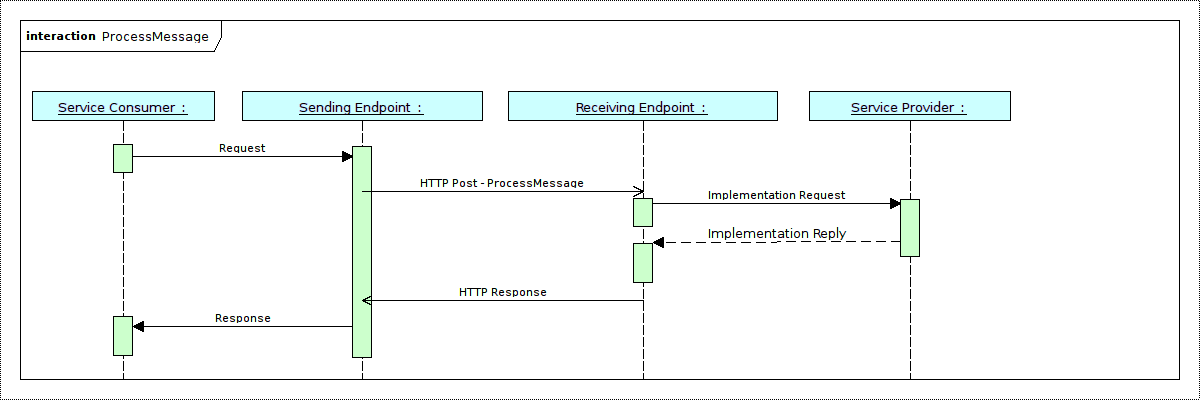
This is the method to use for synchronous communication. It takes a payload element as an input, processes it, and returns a result payload all within one HTTP cycle. After invoking this method, the client keeps the connection open waiting for the response. If a response is not received within a predetermined timeout period, the method is considered to have failed.
In certain situations this method might return a SOAP fault element instead of a payload element. For example, if the sender could not be authenticated or the message is not well formed. Fault Codes are described in Chapter 6, Error Handling for more information. Errors related to business rules, on the other hand, MUST NOT be returned as SOAP faults, but returned using the suitable BOD.
| STAR Level 1 Requirement |
|---|---|
STAR1016: Application level error messages MUST NOT be returned with a SOAP Fault, and MUST be returned using the appropriate BOD. |
Example 2.2. SOAP Body Message
Request:
<soapenv:Body>
   <starws:ProcessMessage>
      <!--Optional:-->
      <starws:payload>
         <!--Zero or more repetitions:-->
         <starws:content id="?">
           < !--You may enter ANY elements at this point-->
        </starws:content>
     </starws:payload>
  </starws:ProcessMessage>
</soapenv:Body>
Response:
<soapenv:Body>
   <starws:ProcessMessageResponse>
     <!--Optional:-->
     <starws:payload>
       <!--Zero or more repetitions:-->
       <starws:content id="?">
          <!--You may enter ANY elements at this point-->
       </starws:content>
     </starws:payload>
   </starws:ProcessMessageResponse>
</soapenv:Body>
The following sequence diagrams show the message exchange sequences for different scenarios.
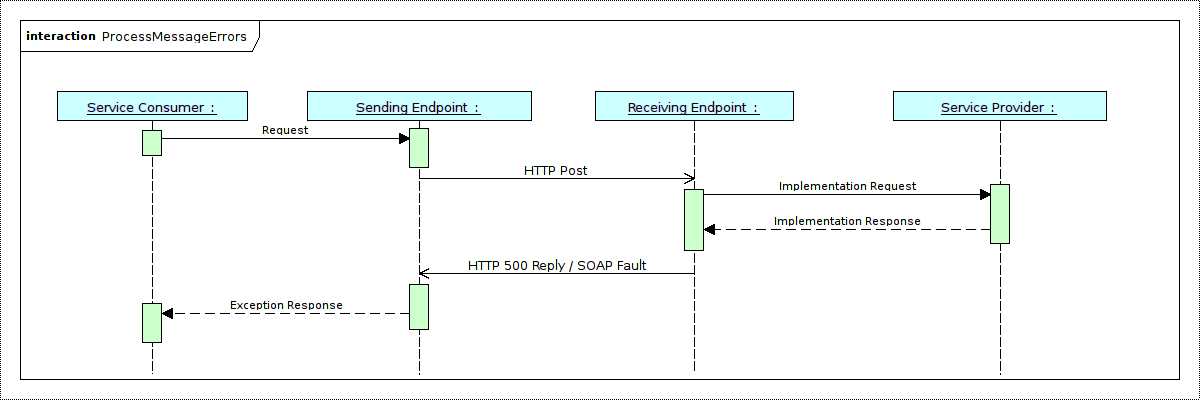
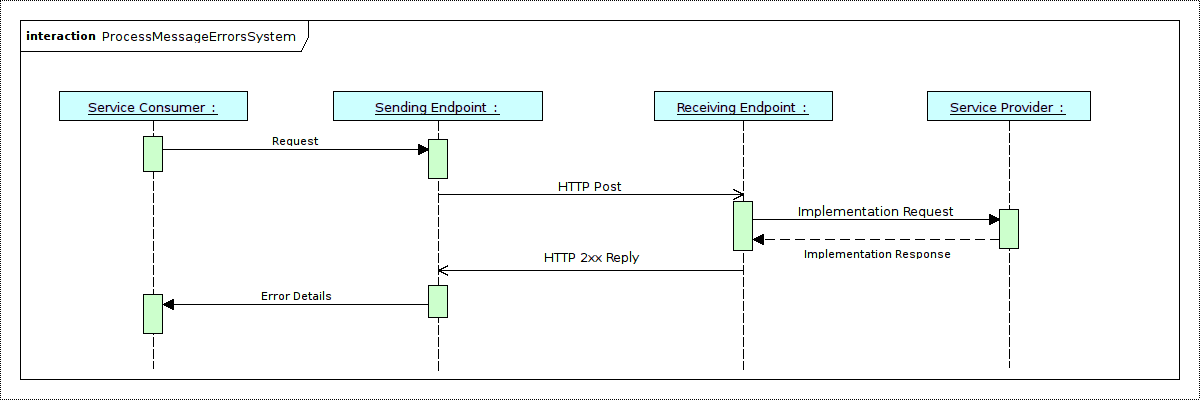
The sequence diagrams that describe the error process are the same whether the PutMessage or PullMessage operation is being implemented instead of the ProcessMessage operation. The processes work the same whether a generic transport or a BOD specific transport is being implemented.
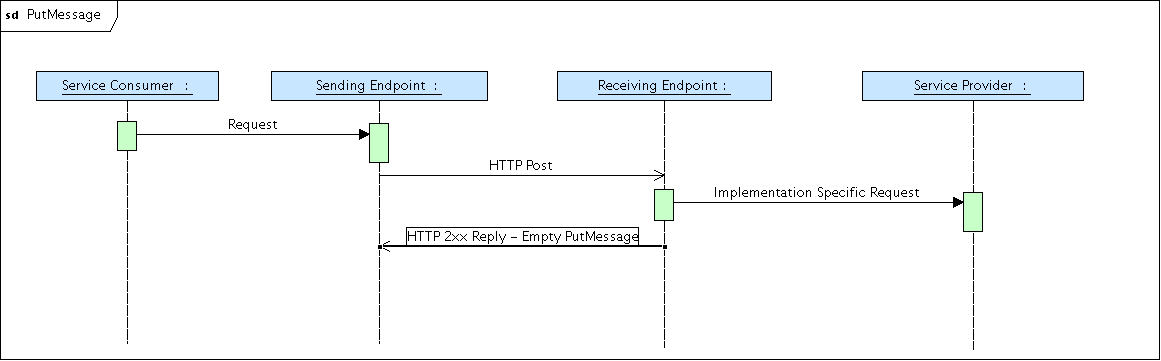
The PutMessage web method is used for asynchronous communication. It accepts a payload element as an input parameter, and returns nothing. Typically, PutMessage is used for messages that do not generate a response or for situations where a response is not returned immediately. The response can be retrieved later by calling PullMessage. The input payload for PutMessage must contain one or more elements.
Although PutMessage does not return any value to the caller, it can return SOAP faults to indicate that the 'put' process was not successful. This typically happens in situations where the message could not be parsed or persisted on the server side. For example, if the SOAP envelope is corrupted and the server can not extract the payload or the sender information then a SOAP fault must be returned on the same connection to inform the sender of the error. Note that business level errors such as invalid values in a BOD should not be returned as SOAP faults, but instead are returned asynchronously (not on the same HTTP connection) in a response BOD that describe the error details. SOAP faults are reserved for errors that prevent the correct parsing or persistence of the message on the server.
Example 2.3. SOAP Message
Request:
<soapenv:Body>
   <starws:PutMessage>
      <!--Optional:-->
      <starws:payload>
         <!--Zero or more repetitions:-->
         <starws:content id="?">
             <!--You may enter ANY elements at this point-->
          </starws:content>
      </starws:payload>
   </starws:PutMessage>
</soapenv:Body>
Response:
<soapenv:Body>
  <starws:PutMessageResponse/>
</soapenv:Body>
In a one-way communication pattern, the client uses PutMessage to send a request to a service provider then sends another request using PullMessage (described in the next section) to pull the response. On the other hand, in a two-way communication pattern, the request is sent using PutMessage, and the response is returned using another PutMessage in the reverse direction.
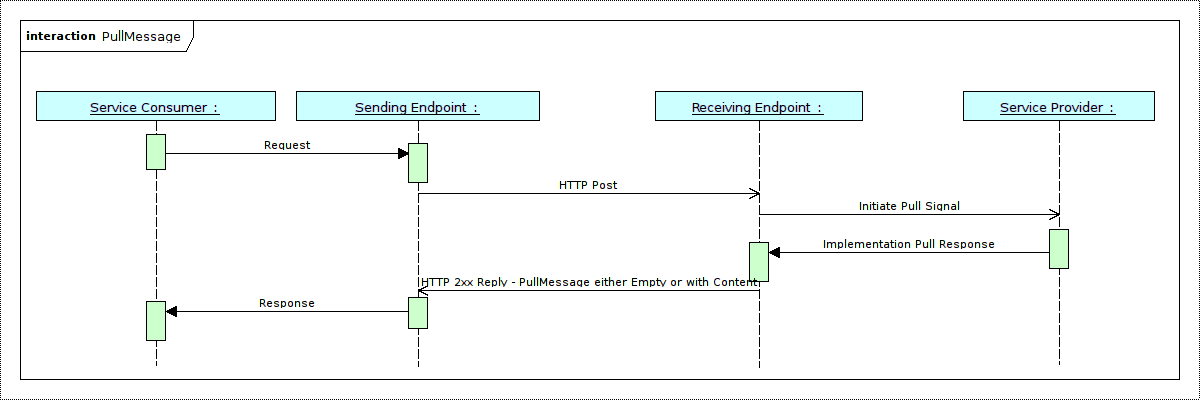
PullMessage is used to retrieve contents from the service provider. The contents can be:
Responses to previous contents (a BOD for example) submitted using PutMessage.
Responses to previous contents submitted using ProcessMessage but could not be delivered back to the requester due to communication or other errors.
Contents that originate from the service provider.
If the client is also a service provider, as in the two-way communication model, PullMessage is not required since both parties can communicate back and forth using PutMessage. However, the parties might choose to still use PullMessage in certain situations.
The service provider must keep track of contents that are deemed to have been received by the client to avoid resending. The client may receive duplicates during error recovery.
| STAR Level 1 Requirement |
|---|---|
STAR1017: The service provider must keep track of contents that are deemed to have been received by the client to avoid resending. STAR1020: The client must be able to handle duplicate messages from a service provider. |
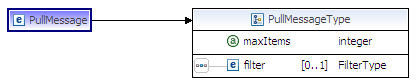
Filter Criteria:
Beginning in 2008 the PullMessage service was extended to support filtering with the addition of the filter complex type and the maxItems attribute. The filter type allows the requesting party to specify criteria that the responding party must apply when selecting the BODs to be returned in the pull message response. The maxItems attribute can be used to limit the number of BODs that will be returned, regardless of whether or not they satisfy the filter criteria.
For example, the filter criteria and maxItems parameters could be used to to satisfy the following request:
"Retrieve all AcknowledgePartsOrder BODs queued for sending in the last 24 hours.Send a maximum of 20 BODs"
A detailed description of the filter component can be found in section 4.5.
Returns:
This operation returns a payload object that carries one or more elements. Or, it returns an empty response with no payload element if there are no queued contents to return.
Example 2.4. SOAP Message with Filter
Request:
<soapenv:Envelope xmlns:soapenv="http://schemas.xmlsoap.org/soap/envelope/"
xmlns:tran="http://www.starstandard.org/webservices/2009/transport">
 <soapenv:Header/>
 <soapenv:Body>
    <tran:PullMessage maxItems="?">
       <!--Optional:-->
       <tran:filter>
          <!--Optional:-->
          <tran:filterConnection connectionID="?" destroy="?"/>
          <!--Optional:-->
          <tran:receiptIDs>
             <!--1 or more repetitions:-->
             <tran:receiptID>?</tran:receiptID>
          </tran:receiptIDs>
           <!--Optional:-->
           <tran:filterCriteria>
              <!--1 or more repetitions:-->
              <tran:criteriaList>
                 <!--1 or more repetitions:-->
                 <tran:criteria>
                    <!--Optional:-->
                    <tran:verb tran:operation="?">?</tran:verb>
                    <!--Optional:-->
                    <tran:noun tran:operation="?"></tran:noun>
                    <!--Optional:-->
                    <tran:applicationID tran:operation="?">?</tran:applicationID>
                    <!--Optional:-->
                    <tran:partyID tran:operation="?">?</tran:partyID>
                    <!--Optional:-->
                    <tran:startDateTime tran:operation="?">?</tran:startDateTime>
                    <!--Optional:-->
                    <tran:endDateTime tran:operation="?">?</tran:endDateTime>
                    <!--Optional:-->
                    <tran:pullStatus tran:operation="?">?</tran:pullStatus>
                    <!--Optional:-->
                    <tran:communicatorID tran:operation="?">?</tran:communicatorID>
                    <!--Zero or more repetitions:-->
                    <tran:predefined tran:operation="?">?</tran:predefined>
                 </tran:criteria>
              </tran:criteriaList>
           </tran:filterCriteria>
        </tran:filter>
      </tran:PullMessage>
   </soapenv:Body>
</soapenv:Envelope>
Response:
<soapenv:Body>
  <starws:PullMessageResponse>
     <!--Optional:-->
     <starws:payload>
       <!--Zero or more repetitions:-->
       <starws:content id="?">
           <!--You may enter ANY elements at this point-->
       </starws:content>
    </starws:payload>
 </starws:PullMessageResponse>
</soapenv:Body>
STAR defines a custom SOAP header to serve as a table of contents for the message. The payload manifest contains one manifest element for each content element in the SOAP body. The manifest provides an easy and fast way to identify the types of data in the message payload without parsing the whole message. This is useful for implementations that make routing decisions based on the contents of the message. And, it is especially useful if the body of the message is encrypted.
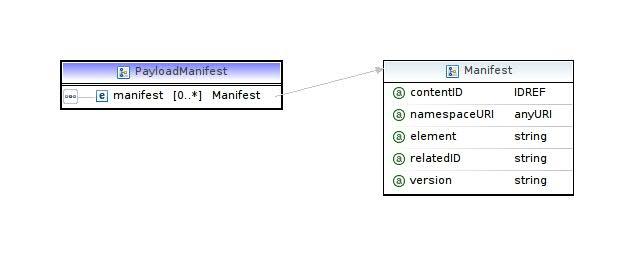
The manifest has the following attributes:
namespaceURI: (Required) -This attribute contains the namespace URI of the XML element in the corresponding content in the SOAP body.
element: (Required) - This attribute contains the local name of the XML element in the corresponding content in the SOAP body.
contentID: (Required)This attribute should be populated with the ID of the corresponding content element. This attribute, along with the id attribute of the content element is used to match the manifest to its corresponding content element.
version (Optional) - When the payload content is a BOD, this attribute contains the version number of the noun's schema used to validate the BOD, for example, 3.01. DTS files use the interfaceVersion of the file. For BOD content and DTS attachments this attribute is required.
| STAR Level 1 Requirement |
|---|---|
STAR1018: A SOAP Header MUST contain one manifest element for each content element in the SOAP body. STAR1019: A manifest is REQUIRED to have namespaceURI, element, contentID, and version attributes. Even though version is listed as optional it is REQUIRED for STAR BOD and DTS transports. |
Table of Contents
In the context of this document, one-way communication refers to the communication pattern in which only one of the communicating parties, the service provider (a.k.a. the server), has an addressable endpoint and the ability to receive and process incoming Web Services messages; and the other parties, the service consumer (a.k.a. the client), can send Web Services requests and receive their response in one HTTP cycle, but does not have an addressable endpoint to receive incoming messages initiated by another party. In this communication pattern, messages always originate from the client to the server.
The client uses ProcessMessage to achieve synchronous communication and receive a response immediately as shown in ProcessMessage sequence diagram earlier. Upon receiving the request, the server starts processing it while holding the connection with the client open until a response (or an error) is ready to be returned to the client on the open connection.
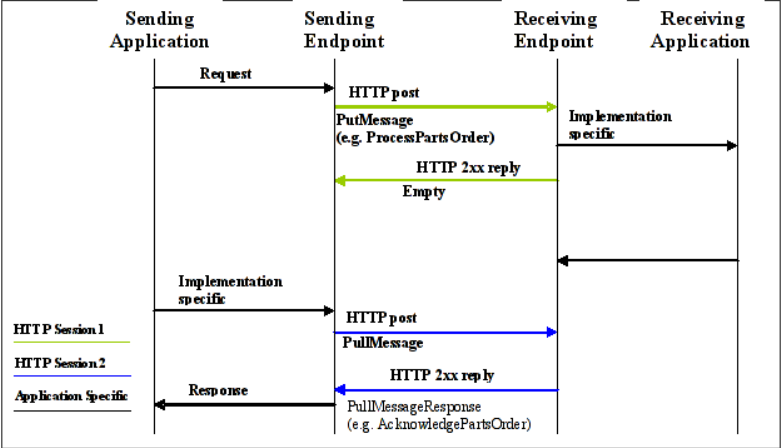
The client can also use PutMessage and PullMessage together to achieve asynchronous communication as shown in the figure below. In this pattern, the client must send a PullMessage request to receive contents queued at the server side. The client can either implement a polling service to periodically request contents from the server or send the requests only when contents are expected to be available for download, for example, through an event notification model, the details of which is out of the scope of this document.
Two-way communication in the context of this document refers to the pattern in which both communicating partners have the ability to initiate and receive messages at the same time. This type of communication is possible if both parties satisfy the service provider requirements described in Service Provider Requirements section.
Synchronous communication is done the same way using ProcessMessage as it is done in the one-way pattern (seeFigure 3.1, “One-way Asynchronous Communication” ). The difference here is that both parties can initiate the requests and hold for a response. Business requirements and an agreement between the two communicating parties determine weather and when synchronous communication is appropriate versus asynchronous communication.
Asynchronous communication changes a little bit from the way it is done in the one-way communication pattern. In the one-way approach, the client sends a request using PutMessage, and then sends another request using PullMessage to download the response from the server. In the two-way approach, the need for PullMessage diminishes and is replaced instead by PutMessage initiated by the server to the client as shown in the figure below.
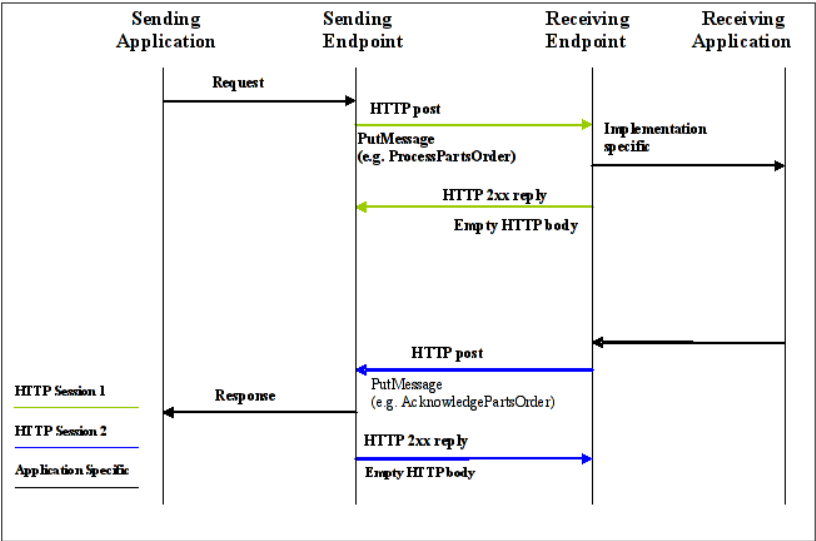
Table of Contents
The specifications define a set of methods and data types to facilitate exchanging synchronous and asynchronous messages using one-way or two-way communication models. This section describes these types and methods and explains how and where they apply.
The generic transport is considered to be a loosely typed WSDL, meaning that it does not fully describe all types of payloads that can occur. It provides meta data about the payload that shows up in the SOAP BODY based on information contained in the SOAP Header manifest, and the content element in the SOAP BODY. The generic transport does exactly what its name implies, allowing the sending and receiving of any type of payload in the soap body. You could technically send a BOD, UBL Message, DTS Transaction, Text, Binary Encoded, etc.
Benefits:
Allows for loosely typed, and loosely coupled systems. Transport and Application are separate
Changes to the data sent in the payload do not necessarily change the WSDL. Meaning the web service does not change because the schema changed.
Considerations:
All transport traffic is going through one end point. This could potentially have scalability issues depending on the amount of data that is coming into the system.
Implementers will need to implement routing and extraction code in order to determine what to do with the payload received.
Need to implement logic in order to handle contents that are not understood.
Need to negotiate out of band using other services to describe what payloads are understood and handled by a particular trading partner.
As discussed in Chapter 2, Common Components, the Pull web service was enhanced for 2008 with a Filter component. This component allows the service requestor to provide optional criteria that the service provider will use to restrict the number and types of BODs that will be returned in the response message. Additionally, filters can be defined as persistent, allowing them to be re-used across multiple Pull requests.
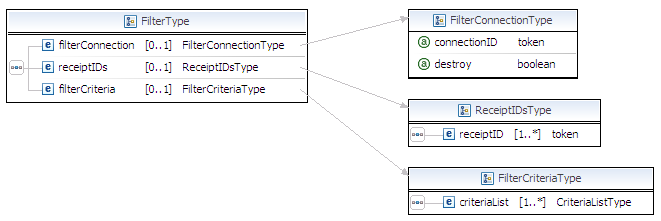
Each service requestor and service provider must implement the code that provides support for the filter component. STAR will provide the specifications for the filter component, however each implementor will be free to choose the method in which they implement the functionality.
The Filter component consists of the following three elements:
Element | Occurrence | Description |
filterConnection | Complex Type | Used to define persistence for the filter |
receiptIDs | Complex Type | Used by service requestor to confirm the receipt of each message requested |
filterCriteria | Complex Type | List of filter criteria to apply to the pull request |
The complete list of elements within the filter criteria component are shown below.
Item | Type | Description |
PullMessage | Complex Type | |
maxItems | Attribute | The maximum number of items to be sent. The service may send less than the number requested but should never send more than the number requested in any one pulling session. |
filter | Complex Type | |
filterConnection | Element | |
connectionID | Attribute | A unique connection id for the filter. Used during persistance of a filter. |
destroy | Attribute | The destroy attribute of FilterConnection will be set to true when the client decides to destroy a persisted filter before all of its applicable messages have been pulled. If and when the client does pull all of the persisted filter's applicable messages, then the web service will automatically destroy the connection and return an empty pull response. If the client does not pull all of a persisted filter's applicable messages and does not explicitly destroy the persisted filter by setting the destroy attribute to true, then based on an agreed upon out-of-band policy, the web service will expire the persisted filter after X number of days. |
recieptIDs | Complex Type | |
receiptID | Element | An unbounded list of content ids that have been previously received since the last pull request. |
filterCriteria | Complex Type | A list of filter criterias to be applied to pulling. |
criteriaList | Complex Type | Criteria contains a unbounded list of filter criteria that can be applied to a queue. If included it is used to specify what should be retrieved. More than one criteria can be specified. Each criteria is it's own filter. |
verb | Element | The OAGIS or STAR Verb. i.e. Process, Acknowledge, Notify, etc |
operation | Attribute | Enumerated List: "and", "or", "not" |
noun | Element | The OAGIS or STAR Noun for a particular BOD. i.e. PartsOrder, CreditApplication, FinancialStatement, etc. |
operation | Attribute | Enumerated List: "and", "or", "not" |
serviceID | Element | identifies the particular service to or from which a message is being sent (e.g. Parts:Orders) |
operation | Attribute | Enumerated List: "and", "or", "not" |
partyID | Element | Assigning Organization Party Id |
operation | Attribute | Enumerated List: "and", "or", "not" |
startDateTime | Element | Indicates the beginning time/date range of messages to be retrieved during this pull session. Based on the time/date at which each message was originally queued for delivery. |
operation | Attribute | Enumerated List: "and", "or", "not" |
endDateTime | Element | Indicates the ending time/date range of messages to be retrieved during this pull session. Based on the time/date at which each message was originally queued for delivery. |
operation | Attribute | Enumerated List: "and", "or", "not" |
pullStatus | Element | The status of an item to be pulled. (i.e. Pulled, Ready, etc.) |
operation | Attribute | Enumerated List: "and", "or", "not" |
communicatorID | Element | Identifer of the party on behalf of which the pull call was submitted. This could be the ID of the calling party or it may be an alternate party if the pull request is being proxied by another service. |
operation | Attribute | Enumerated List: "and", "or", "not" |
predefined | Element | These are complex queries or queries that can't be represented using the current filter criteria. They may contain if then else logic, and are identified by a name. (i.e. GetWidgetsGreaterThan10) |
operation | Attribute | Enumerated List: "and", "or", "not" |
How is the generic transport implemented by STAR? As has been outlined in Chapter 2, Common Components, the generic transport will implement the Manifest, and Content elements in the Soap Header and Body respectively.
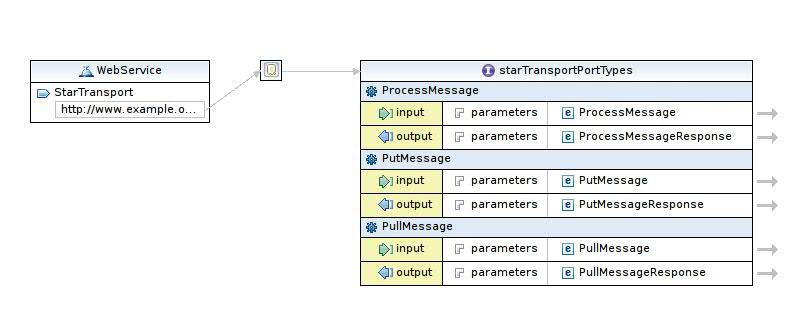
As is depicted in the figure below, the WSDL implements the ProcessMessage, PutMessage, and PullMessage methods and operations. The following examples will use the ProcessMessage method to indicate the structure of the SOAP Body. A sample Generic Transport WSDL can be found with the STAR Schema Repository.
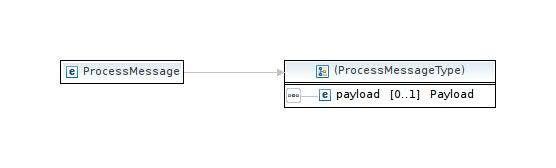
The generic transport will use one common payload element definition.This is the Payload type. The payLoad type contains the definition for the content elements.
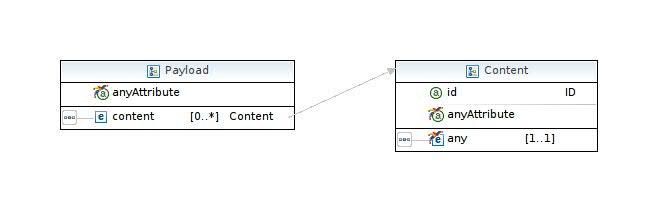
The Generic content element refers to a complex Type definition that defines an xsd:any as the content for the element. What this says, is that any type of XML or Text can be put here. It is not locked to a particular type of data to be sent or received. Information about the content is located in the Manifest elements and linked by an id. There may be unlimited number of content elements sent in the payload, and each links back to a particular manifest element.
The receiving web service would process the Manifest to determine what it actually received, and do any appropriate routing or processing of the payload contained within it.
Example 4.1. Sample Generic Message
<?xml version="1.0" encoding="UTF-8"?>
<soapenv:Envelope xmlns:soapenv="http://schemas.xmlsoap.org/soap/envelope/"
                      xmlns:starws="http://www.starstandard.org/webservices/2009/transport">
   <soapenv:Header>
      <starws:payloadManifest>
         <!--Zero or more repetitions:-->
         <starws:manifest contentID="?" namespaceURI="?" element="?" relatedID="?"
                    version="?"/>
      </starws:payloadManifest>
   </soapenv:Header>
   <soapenv:Body>
      <starws:ProcessMessage>
         <starws:payload>
            <!--Zero or more repetitions:-->
            <starws:content id="?">
               <!--You may enter ANY elements at this point-->
            </starws:content>
         </starws:payload>
      </starws:ProcessMessage>
  </soapenv:Body>
</soapenv:Envelope>
Table of Contents
Choosing either a BOD Specific transport or a Generic transport does have architectural implications. However, the choice does not have to be one or the other, both can be used together. The choice should be based on what best fits the overall architectural and system needs for the Web Services to be implemented.
What is a BOD Specific WSDL? A BOD Specific WSDL is a version of the STAR Web Services Transport specification that expects to send and receive only a specific type of BOD in its transaction life cycle. If it receives anything other than what it expects, it will send back a SOAP Fault to indicate that the wrong payload was sent. According to Russell Butek from IBM, "WSDL is the Web Services Description Language. Its charter is to describe an interface to a service as completely as possible. When you use xsd:any, you deviate from this intent of the WSDL". [Butek2005] In other words, a Generic transport does not fully describe a web service; it leaves key information about the payload out. This has the advantage of allowing the transport to remain generic but shifts the determination of the content and what to do with the content received to another portion of the system.
A BOD Specific WSDL will fully describe all aspects of the Web Service's capabilities, including the type of payload that can be received and the expected responses. BOD specific WSDL is considered to be a strongly typed WSDL. More information in regards to strongly typed and loosely typed WSDL definitions can be found in the IBM Developerworks article, "Loosely typed versus strongly typed Web Services" by Andre Tost.
Benefits:
BOD specific WSDL fully describes the Web Services Interface and the type of services it offers. The WSDL is considered to be strongly typed.
BOD specific WSDL specifies clearly what is to be sent to the service and what is to be returned.
BOD specific WSDL's are more compatible with existing development tools that generate code from the WSDL. These tools work best when they can describe the full capabilities, and not have to leave pieces to be filled in outside of their framework.
Services using BOD Specific WSDL's do not require additional processing by the SOAP engine to figure out the type of payload being received.
Data Validation of the payload can happen before it reaches the application, as it is validated by the type of content the Web Service expects to receive.
Considerations:
Changes can create backward compatibility issues. If the strongly typed data in the WSDL changes or breaks compatibility, code that depends on the WSDL may need to be regenerated.
Strongly typed interfaces require more logic upfront in the Transport dealing with the payload and parsing of the information. The amount depends on the size and complexity of the payload.
There is a closer tie between the transport and application, potentially requiring closer testing between the two.
So how does a BOD Specific WSDL look when implementing the STAR Web Services Transport? STAR includes with the XML Schemas for STAR 5 the BOD Specific WSDL for all the BODs. These are grouped by the recommended Verb and Noun pairing outlined in the Verb Usage Guidelines available on the STAR Website. The WSDL files may be found in the following directory:
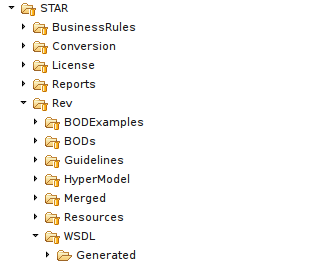
There are roughly about 60 WSDL definition files, and these are automatically generated with the base information necessary for minimum compliance with the STAR Web Services transport. These WSDL files do not implement any of the Security, or Reliable Messaging that may be needed by a particular implementation. They are provided as templates for users to update for their particular requirements.
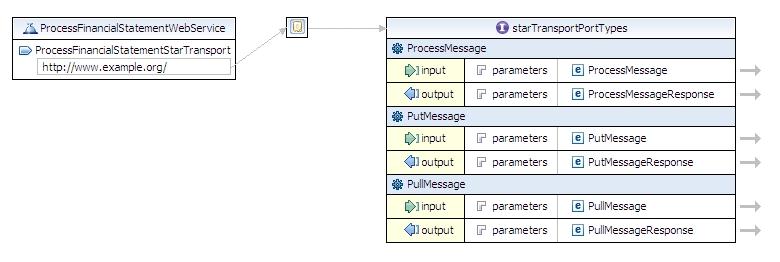
On the surface, there is little difference between the structure of the BOD Specific WSDL and a generic transport. You still have operations, transport types, bindings, messages, and services. The root soap body elements that carry the payload are still the same, and the manifest information that is transmitted is the same as well. These all have to be the same for both a generic and BOD specific WSDL to be able to interoperate with each other.
Differences start to show once you reach the definition of the elements that make up the operation as shown in the figure belowFigure 19.

A BOD specific WSDL will refer to a very strongly typed definition for the payload element. This allows the WSDL to fully describe the type of content expected to be sent with the type of operation that is being invoked. Further, the payload element itself describes the type of BOD to be carried and the multiplicity of the content.It also describes where attachment data should occur and in what order the payload information should be sent.
If schema validation is performed and the information does not appear in the order that is specified, a SOAP fault must be returned before the information ever reaches the receiving application.
Table of Contents
It is important to use HTTP errors, SOAP Faults, or BOD level errors consistently. However, this section acknowledges implementations may use different error mechanisms for the same types of errors. This section defines general guidelines between these error mechanisms and also refers to the appropriate STAR documentation with regard to BOD level error handling.
Across STAR transports, the mechanism of error reporting should be as consistent as possible.
To align with the above principle, communicate as many errors as possible within BODs and minimize the amount of errors communicated in a transport specific way (such as SOAP Faults).
Other principles specific to BOD level errors are detailed in the STAR Confirm BOD Implementation Guidelines.
Implementations MUST NOT communicate errors using mechanisms other than those defined by STAR documents, or use error codes not defined or approved by STAR.
The types of errors which can occur when a Web service client attempts to communicate with a Web service can be thought of as a spectrum. At one end of the spectrum are the pure transport related errors and at the other end are the errors resulting from the business processing of the BOD. The mechanisms used to communicate these errors differ. 4.2.2-1 depicts an example specific to the use of Web services over HTTP. Other transport level protocols may have other exceptions. Although many types of errors are shown, this list is not intended to be all-inclusive.
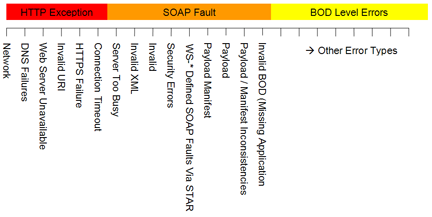
The general guidelines with the approach shown here are the following:
HTTP exceptions are truly transport specific. SOAP Faults include the following types of errors:
True Web service transport specific errors (e.g., Invalid operation and server too busy)
SOAP Faults defined as part of a Web service standard like WS-Security implemented by this document (e.g., FailedAuthentication)
SOAP Faults due to manifest and payload inconsistencies
SOAP Faults due to business level errors that could not be returned in a BOD.
BOD level errors are preferred over the previous transport specific errors; therefore, if the application area of the BOD is obtainable and the error is not a transport error, BOD level error handling SHOULD be used. Refer to the STAR Confirm BOD Implementation Guidelines for details on BOD level errors.
HTTP Errors are those that occur at the transport layer when trying to call the web service and the web service client should handle them according to WSI basic profile 1.1.
Web service client should check for the HTTP return code 200 to ensure the transaction that was attempted went through ok. If the client receives any HTTP return code other than 200, it should be handled accordingly. Typical situations an HTTP error could occur are as follows:
Common STAR HTTP Error Codes:
| Description | Error Code |
| When the web server where the web service is being hosted is down or not available. | 404 |
| When the DNS server is unable to resolve the domain name in the Endpoint. | 400 or 500 |
| When the Endpoint of the web service is not available. | 503 |
| When the SSL Handshake Failure occurs between the Client and the Web Server. | 500 |
| When the Web Service does not recognize the request sent by the client. | 502 |
| When the HTTP Request time out occurs. (NOTE: This is not the same as the timeout error we see in the SoapFault.) | 408 |
For a more details on all type HTTP error codes and details of each error code and description please refer to RFC2616 Section 10. [RFC2616.10]
SOAP faults are used to indicate error situations that prevent the successful delivery of STAR contents for subsequent parsing and processing. While this specification does not prevent using SOAP faults to communicate business level errors generated by business rules, this specification RECOMMENDS that these types of errors be returned using the proper BOD type such as a ConfirmBOD or the corresponding Acknowledge BOD.
If you send a message that was not successful you may get back a response containing a SOAP fault element which gives you status information, error information, or both. A SOAP Fault is similar to an Exception object in common development platforms in that it conveys information about a problem that prevents further processing. Some STAR-specific SOAP fault codes have been defined for common faults. All STAR implementations must understand these faults and handle them accordingly. Standard SOAP faults should be preferred over custom fault codes, such as when WS-Security or the WS-I Basic Profile define specific faults to be used. Below is a list of common faults that have been defined by STAR. When used, the fault code must be prefixed by “STAR:” and appear as in STAR:Invalid Structure.
Note: When sending a SOAP Fault the HTTP Status code needs to be set to 500, according to the WS-I Basic Profile.
Table 6.1. STAR Standard Soap Faults
| Fault Code | Description |
|---|---|
| Duplicate Document | This code refers to a document that already exists. This may happen for a BOD such as ProcessPartsOrder where the document identifiers to another existing parts order from the same dealer. |
| Not Authorized | This code occurs when the client attempts to perform an operation that is not authorized for the given action. This is not to be used for Authentication errors. Those should use the appropriate WS-Security SOAP Fault. |
| Server Error | An error (e.g. database server is down) on the server prevented the execution of the BOD. The client will have to resend the BOD at a later time. |
| BOD Not Supported | The received BOD or BOD version is not supported b the receiver. |
| Invalid Structure | The structure of the BOD is not valid. For example, the BOD failed schema validation. |
| Invalid BODID | A BODID was missing or is Invalid. |
| Time Exceeded | The processing time will exceed the real time transaction allowed time. Must resend with a Put for batch processing, and pull to receive the message. |
A SOAP Fault object contains the following elements:
Fault code: Always required. The fault code must be a fully qualified name: it must contain a prefix followed by a local name. The SOAP specifications define a set of fault code local name values, which a developer can extend to cover other problems.
Fault string: Always required. A human-readable explanation of the fault.
Fault actor: Required if the SOAP Header object contains one or more actor attributes; optional if no actors are specified, meaning that the only actor is the ultimate destination. The fault actor, which is specified as a URI, identifies who caused the fault. For an explanation of what an actor is, see the actor attribute.
Detail object: Optional element. The SOAP Fault object may contain a Detail object that gives details about the problem.
Below is an example of a SOAP message carrying a valid Fault element:
Example 6.1. Sample SOAP Fault
<?xml version="1.0" encoding="utf-8"?>
<soap:Envelope xmlns:soap="http://schemas.xmlsoap.org/soap/envelope/">
   <soap:Header>
   </soap:Header>
   <soap:Body>
     <soap:Fault>
        <faultcode>soap:Server</faultcode>
        <faultstring>Database server not available.</faultstring>
        <faultactor>http://localhost/WebServices/STAR/STARTransport.asmx</faultactor>
     </soap:Fault>
   </soap:Body>
</soap:Envelope>
SOAP 1.1 defines the following standard fault codes under the SOAP namespace ("http://schemas.xmlsoap.org/soap/envelope/"):
Client: This code should be used when an error is found in the received message. The error could be anything from a corrupted message to a missing required element. This fault code indicates that the received message is the cause of the error and that the client is to blame.
Server: This fault code indicates that a problem at the server prevented the processing of the message. The error could be anything from an overloaded server to a failing database.
These fault codes represent classes of errors rather than specific errors. SOAP 1.1 allows extending the fault codes using the period notation, however this practice is discouraged by the WS-I Basic Profile 1.1 to avoid the risk of potential name conflicts.
| STAR Level 1 Requirement |
|---|---|
STAR1009: All STAR Web Services are REQUIRED to understand and handle the STAR Specific SOAP Faults. STAR1010: All STAR soap fault error codes are REQUIRED to be be prefixed with STAR: and the appropriate STAR error code. i.e. STAR:Invalid Structure. STAR1011: All STAR soap fault error codes are REQUIRED to appear in the standard SOAP:Fault block. STAR1012: SOAP Faults are for Critical Processing errors only. Informational or warning errors SHOULD NOT be sent as a SOAP Fault. |
Note that some specifications mentioned in this document define their own SOAP faults. For example, WS-Security defines a set of fault codes to address security related errors. These fault codes are described in the WS-Security section and should be used when appropriate.
| STAR Level 1 Requirement |
|---|---|
STAR1014: WS-Security errors must send the appropriate WS-Security SOAP Fault for the authorization being used. |
Below are examples of different error situations and valid responses that a service provider can reply with.
Error Case | Valid Response (ConfirmBOD or SOAP Fault) |
Wrong ProcessMessage namespace | Fault: soap:Client |
Wrong BOD namespace | Fault: soap:Client |
Misspelled BOD root element | ConfirmBOD: BodNotSupported Fault: soap:Client |
Invalid or missing <Task> element | Fault: soap:Client Fault: wsse:FailedAuthentication ConfirmBOD: BodNotSupported ConfirmBOD: FieldMissing ConfirmBOD: InvalidBod |
Missing <ReferenceId> | Fault: soap:Client ConfirmBOD: FieldMissing |
Missing <DealerNumber> | Fault: soap:Client Fault: wsse:FailedAuthentication ConfirmBOD: FieldMissing |
Invalid dealer number | Fault: wsse:FailedAuthentication ConfirmBOD: InvalidValue |
Missing <BODId> | Fault: soap:Client ConfirmBOD: FieldMissing |
Message too old (wsse:Security\wsu:Timestamp\wsu:Expires has expired) | wsu:MessageExpired |
Missing Application Area | Fault: soap:Client Fault: wsse:FailedAuthentication ConfirmBOD: InvalidBod |
Missing Data Area | Fault: soap:Client ConfirmBOD: InvalidBod |
Invalid User ID in wsse:Security header | wsse:FailedAuthentication |
Wrong password in wsse:Security header | wsse:FailedAuthentication |
Corrupted XML | HTTP/1.1 400 Bad Request (specified by WS-I Basic Profile) |
Wrong SOAP Action HTTP header | soap:Client |
Wrong SOAP Action in HTTP header and wsa:Action | soap:Client |
Misspelled wsse:Security namespace | wsse:SecurityTokenUnavailable |
Application level errors are those that occur once the payload has made it into the application for processing. The BOD that returns these errors could either be a Acknowledgement or a Confirm depending on the verb that was used to send the BOD. If a Process verb is used, then an Acknowledgement Verb is the appropriate response. Confirm BOD could technically be used in almost any situation, but it is an OAGi recommendation that application level errors be handled where possible by the corresponding response Verb.
The following messages may occur at a ConfirmBOD or SOAP Fault level. This depends on how the implementation is architect-ed on the back end system. While the ConfirmBOD can send back Warnings, SOAP Faults are restricted to errors that stop processing of the message. Warnings are not included in the list for this reason. There are also some concerns about warnings on how these should be handled from an interoperability standpoint.
All of the codes listed in the following table are to be treated as ERRORS.
| STAR Level 1 Requirement |
|---|---|
STAR1013: ConfirmBOD reason codes that are sent at the Warning or Informational status, should not trigger a resending of the BOD. |
| Description | Code |
| A doucment already exists. This may happen for a BOD such as ProcessPartsOrder where the document identifiers to another existing parts order from the same dealer. | Duplicate Document |
| One or more required data elements have invalid values. | Invalid Required Value |
| The operation that cannot be performed, such as Change or Cancel based on the receiver's business rules and the condition of the document. For example, the part order has already been shipped therefore the order cannot be cancelled. | Cannot Perform |
| One or more required fields are missing. | Required Field Missing |
| An error (e.g. database server is down) on the server prevented the execution of the BOD. The client will have to resend the BOD at a later time. | Server Error |
| The client attempts to perform an operation that is not permitted. An example of when this may occur is if the dealer attempts to order a part when their account is placed on hold. This is to be used for authorization errors | Not Permitted |
| The received BOD or BOD version is not supported by the receiver. | BOD Not Supported |
| The structure of the BOD is not valid. For example, the BOD failed schema validation. | Invalid Structure |
Table of Contents
The following sections define the implementation details to meet the Star Transport Guidelines security requirements when using Web Services.
The following specifications are used to accomplish secure web services communication until further clarifications and standards emerge from the Web Services Security technical committee in Oasis:
HTTPS: Provides a secure transport channel
Web Services Security: SOAP Messaging Security V1.0: Provides the framework for SOAP messaging security.
Web Services Security: Username Token Profile V1.0: Describes user authentication tokens.
The security methods described in this section can be applied to all the web services methods mentioned earlier on both requests and responses. Communication partners will need to agree on which security methods to use and on which types of communication. The choice will also be affected by business rules, performance and information sensitivity. As a base standard all STAR endpoints and clients MUST send information encrypted using HTTPS and comply with the security requirements outlined by the WS-I Basic Security Profile 1.0.
| STAR Level 1 Requirement |
|---|---|
STAR1004 : All implementations are REQUIRED to send information over HTTPS. |
WS-I Basic Security Profile 1.0 consists of a set of non-proprietary web services specifications, along with clarifications to and amplifications of those specifications which promote interoperability.
| STAR Level 1 Requirement |
|---|---|
STAR1008 : All services and clients must be compliant to the general Security requirements Outlined by the WS-I Basic Security Profile 1.0 .The optional attributes defined in the Profile is also to be relaxed in the STAR Implementation. |
STAR Level 1 implementations when using Username/Password for authentication MUST implement the rules specified by the WS-I Basic Security Profile.
WS-Security defines the Security SOAP header to carry security information in SOAP messages. Information included in this element includes, but not limited to, authentication credentials, digital signatures, and encryption references. To specify security information for intermediary processing, use the actor element on the Security SOAP header. WS-Security specifies the wsu:Timestamp element as a child of the wsse:Security header.
Example 7.1. Sample of WS-Security
<soap:Header>
   ...
   <wsse:Security>
      <wsu:Timestamp>
         <wsu:Created>2003-06-04T03:48:32Z</wsu:Created>
         <wsu:Expires>2003-06-04T03:53:32Z</wsu:Expires>
      </wsu:Timestamp>
      ...
   </wsse:Security>
   ...
</soap:Header>The STAR Transport Group has selected Username/Password as the base method of authentication. The ability to authenticate via username and password is a base standard that all services must implement for the sake of interoperability.
| STAR Level 1 Requirement |
|---|---|
STAR1003 : All implementations are required to support Username/Password for authentication. |
WS-Security defines a UsernameToken element to be used to pass the username and password. Below is the XML syntax of this element.
Example 7.2. WS-Security Username and Passoword
<wsse:UsernameToken wsu:Id="...">
   <wsse:Username>...</wsse:Username>
   <wsse:Password Type="...">...</wsse:Password>
   <wsse:Nonce>...</wsse:Nonce>
   <wsu:Created>...</wsu:Created>
</wsse:UsernameToken>
Two methods to include the password are supported:
Plain Text, in which the password is passed in clear text
Hashed, in which the password is not transmitted, but instead, a one-way hash is generated from the password and used for authentication
If a clear text password is used then it is required that the appropriate transport level encryption is used, such as HTTPS. All passwords must be stored or persisted in an encrypted format.
The <wsse:Username> element carries the client identifier. For example, if the client is a dealer and the service provider is an OEM, the Username element will be the dealer’s identifier. Different service providers require different types of identifications to identify their clients. Therefore, the syntax of this element is flexible and will be agreed upon between the two communication partners.
Below are other possible examples on using the username field:
A password can be sent in clear text if a secure communication channel, such as HTTPS, is available between the sender and the receiver.
Example 7.7. Plain Text Password
<wsse:Security soap:mustUnderstand="1">
   <wsu:Timestamp>
      <wsu:Created>2003-06-04T03:48:32Z</wsu:Created>
      <wsu:Expires>2003-06-04T03:53:32Z</wsu:Expires>
   </wsu:Timestamp>
   <wsse:UsernameToken>
      <wsse:Username>JohnDoe</wsse:UserName>
      <wsse:Password
    Type="http://docs.oasis-open.org/wss/2004/01/oasis-200401-wss-username-token-profile-1.0#PasswordText">Password</wsse:Password>
   </wsse:UsernameToken>
</wsse:Security>When a secure channel is not available, or when the message goes through intermediaries, a password digest can be used to avoid revealing the password. WS-Security defines fields and algorithms to carry authentication information securely. The specifications use a one-way hashing algorithm, SHA1, to encrypt the combination of the password, a time stamp, the creation date/time, and a nonce (randomly generated string) to generate a digest. The resulting digest is base 64 encoded SHA1 hash value that is carried in the UsernameToken and verified on the server side.
Below is an example of a UsernameToken carrying a password digest:
Example 7.8. Password Digest
<wsse:Security soap:mustUnderstand="1" >
   <wsu:Timestamp>
      <wsu:Created>2003-06-04T03:48:32Z</wsu:Created>
      <wsu:Expires>2003-06-04T03:53:32Z</wsu:Expires>
   </wsu:Timestamp>
   <wsse:UsernameToken wsu:Id="SecurityToken-8a45f51b-fe46-4715-bdae-e596c36ad6be">
      <wsse:Username>JohnDoe</wsse:Username>
      <wsse:Password
        Type="http://docs.oasis-open.org/wss/2004/01/oasis-200401-wss-username-token-profile-1.0#PasswordDigest">
         RvaxAmb2KhEQpFFJE+YXcyRy6E8==
      </wsse:Password>
      <wsse:Nonce>X6y15GC/WLYP8XY/YR3iIQ==</wsse:Nonce>
      <wsu:Created>2003-06-04T03:48:32Z</wsu:Created>
   </wsse:UsernameToken>
</wsse:Security>
The advantages of the digest method over the clear text method are:
Passwords are not transmitted over the wire
Since the Created element is included in the generation of the digest, the message recipient can reduce the risk of replay attacks by inspecting this element and rejecting messages that are older than a set time window.
To further reduce the risk of replay attacks the recipient can reject all messages that come with duplicate nonce values since nonces are generated to be unique. To accomplish this functionality, the server needs to store the nonce values of incoming messages for a period of time greater or equal to the expiration duration of the message, and compare the nonces of incoming messages to the stored ones.
There are situations in which a password digest cannot be used, such as when the password is not available to both: the client and the server (when using LDAP binding, for example).
The WS-Security specifications define a set of SOAP Fault codes to describe different error situations that may occur during the parsing of the security headers and authenticating or authorizing the requests. Sending a SOAP Fault back is not required because this could be used as part of a denial of service or cryptographic attack. However, if an error is sent back, it MUST use the SOAP Faults defined in the WS-Security specifications.
Here is a list of the fault codes as defined in WS-Security 1.0:
Fault Code | Description (Fault String) |
wsse:UnsupportedSecurityToken | An unsupported token was provided |
wsse:UnsupportedAlgorithm | An unsupported signature or encryption algorithm was used |
wsse:InvalidSecurity | An error was discovered processing the <wsse:Security> header. |
wsse:InvalidSecurityToken | An invalid security token was provided |
wsse:FailedAuthentication | The security token could not be authenticated or authorized |
wsse:FailedCheck | The signature or decryption was invalid |
wsse:SecurityTokenUnavailable | Referenced security token could not be retrieved |
wsu:MessageExpired | Security semantics are expired. |
This section describes the necessary components and pieces that all STAR Level 2 compliant implementations must implement.
Table of Contents
The following sections define the implementation details to meet the STAR Transport Guidelines security requirements when using Web Services for STAR Level 2 requirements. All security requirements from STAR Level 1 still apply to STAR Level 2.
The following specifications are used to accomplish secure web services communication until further clarifications and standards emerge from the Web Services Security technical committee in Oasis:
HTTPS: Provides a secure transport channel
Web Services Security: SOAP Messaging Security V1.0: Provides the framework for SOAP messaging security.
Web Services Security: X.509 Token Profile V1.0: Describes the use of digital certificates.
The security methods described in this section must be applied to all the web services methods mentioned earlier on both requests and responses.
| Note |
|---|---|
STAR Level 2 implementations must still implement all requirements from STAR Level 1 in regards to security. STAR Level 2 requirements are enhancements to STAR Level 1. Implementations must fall back gracefully to STAR Level 1 if the trading partner can not support the STAR Level 2 requirements. |
In order to help inform clients and trading partners consuming a STAR Level 2 service using Digital Certificates for authentication, it is recommended that STAR implementations state their conformance to the WS-I Basic Security Profile.
Example 8.1. WS-I Basic Security Profile Conformance Claim
<wsdl:definitions xmlns:wsdl="http://schemas.xmlsoap.org/wsdl"
  xmlns:tns="http://example.org/myservice"
  xmlns:soapbind="http://schemas.xmlsoap.org/wsdl/soap"
  xmlns:wsi="http://ws-i.org/schemas/conformanceClaim/"
  targetNamespace="http://example.org/myservice">
  <wsdl:portType name="MyPortType">
      ...
  </wsdl:portType>
  <wsdl:binding name="MyBinding" portType="MyPortType" >
      ...
  </wsdl:binding>
  <wsdl:service name="MyService" >
    <wsdl:port name="MyPort" binding="tns:MyBinding" >
      <wsdl:documentation>
        <wsi:Claim
         conformsTo=”http://ws-i.org/profiles/basic-security/1.0/x.509-certificate-token” />
      </wsdl:documentation>
      <soapbind:address
       location="http://example.org/myservice/myport" />
    </wsdl:port>
  </wsdl:service>
</wsdl:definitions>
By including the conformance claim within the WSDL for a service, clients of the service are made aware of the endpoint's conformance to the specified target. Clients can then test to make sure that their implementations are conformant as well as verify that the web service is indeed conformant to the specified profile/target.
WS-I Basic Security Profile 1.0 consists of a set of non-proprietary web services specifications, along with clarifications to and amplifications of those specifications which promote interoperability.
STAR Level 2 implementations when using Digital Certificates for authentication MUST implement the rules specified by the WS-I Basic Security Profile. In particular implementations must be conformant to section 12.
Conformance Targets. Conformance targets identify what artifacts (e.g., SOAP message, WSDL description) or parties (e.g., SOAP processor, end user) requirements apply to . This allows for the definition of conformance in different contexts, to assure unambiguous interpretation of the applicability of requirements, and to allow conformance testing of artifacts (e.g., SOAP messages and WSDL descriptions) and the behavior of various parties to a Web service (e.g., clients and service instances). STAR implementations or derivation of STAR transport web services will align to one of the conformance targets as mentioned in the Basic Security Profile 1.0.
| STAR Level Two Requirement |
|---|---|
STAR2002: Implementations must conform to section 12, "X.509 Certificate Token" of the WS-I Basic Security Profile 1.0. |
The WS-I Basic Security Profile indicates that the BinarySecurityToken Value Type attribute be http:// docs.oasis-open.org/wss/2004/01/oasis-200401-wss-x509-token-profile-1.0#X509v3. If referencing a certificate path, the BinarySecurityToken should be one of:
http://docs.oasis-open.org/wss/2004/01/oasis-200401-wss-x509-token-profile-1.0#X509PKIPathv1
http://docs.oasis-open.org/wss/2004/01/oasis-200401-wss-x509-token-profile-1.0#PKCS7
The profile indicates that X509PKIPathv1 is recommended for efficiency.
Digital certificates can be used for a number of purposes, including digital signatures, data encryption, or server and client authentication. Certificates are typically used to establish or verify the identity of one or both parties in an electronic conversation. For those that need a higher level of security than is provided by the STAR Level 1 requirement of username/password authentication, STAR requires the use of Digital Certificates for authentication.
| STAR Level Two Requirement |
|---|---|
STAR2001: Level 2 implementations must use X509 certificates. |
Digital certificates can be used for a number of purposes, including digital signatures, data encryption, or server and client authentication. Certificates are typically used to establish or verify the identity of one or both parties in an electronic conversation.
In order for certificates to be useful, each party must be able to determine that the certificate they receive from the other party is genuine and that it has not been forged or tampered with. The PKI infrastructure provides this through the use of the Certificate Authority (CA). A CA is a trusted party that issues certificates on behalf of the parties that they represent. A certificate issued by a CA will contain the CA's "digital signature" to verify that the certificate is authentic. The party receiving the certificate can compare the CA signature to a copy that it maintains in its local certificate store to verify its authenticity.
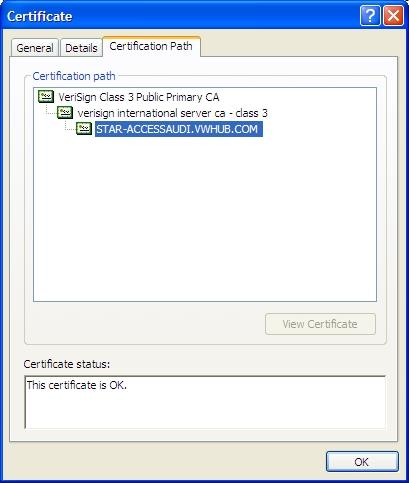
Verisign, Entrust, and Thawte are all well-known CAs. A certificate provided by a well-known CA will contain its root certificate, and possibly an intermediate certificate. The example below is a certificate that was signed by Verisign. If the CA is trusted by an organization that is confident of its identity, its public root certificate and any intermediate certificates can be added to a trusted root keystore. Applications that use the keystore should accept any certificates that contain a valid signature from the trusted CA, with the exception of those certificates that the CA may distribute in a Certificate Revocation List (CRL). Third-Party certificates are most commonly used as server side SSL certificates, however they can be used for client certificates as well.
All modern web browsers come pre-loaded with the root certificates for the well-known CAs in their trusted certificate keystore. If you are building a custom solution that does not require a web browser, you can either clone the keystore that ships with any browser or manually import the certificates into your trusted keystore.
While the well-known CAs can be a reliable certificate source, they can also become expensive. Certificates from one of the well-known CAs must be purchased, typically on an annual basis. If you plan to generate many certificates then this method could become cost-prohibitive.
The PKI infrastructure allows any organization to create its own private CA for signing its own certificates. Certificates signed by a private CA will look similar to those signed by a well-known CA in that the root certificate within the chain will belong to the CA. Figure 8.2, “Example of Certificate Signed by Private CA” is an example of a certificate signed by a private CA.
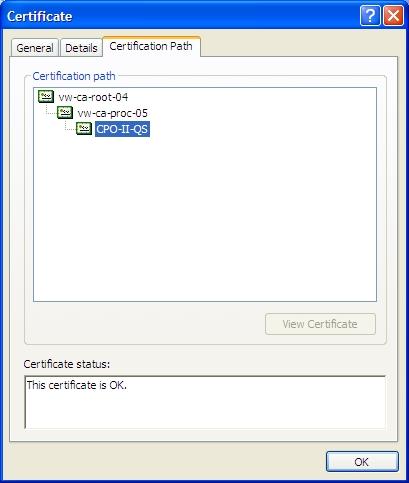
The benefit of using a private CA is that the organization does not have to purchase its certificates. The drawback to using a private CA is that the CA’s root certificate will not come pre-loaded with any of the commercially shipped keystores. The owner of the CA will typically perform an out-of-band communication with its business partners to verify its identity. The CA owner will then provide each of its business partners with a copy of its public root certificate. The business partners can then import the root certificate into their local trusted certificate keystore. Any certificates signed by the CA can then be validated against the root certificate in their trusted keystore.
While private CAs may not provide the industry-wide validation that well-known CAs offer, they can still offer a safe and reliable solution for using certificates.
The third method of generating a certificate is to use a self-signed certificate. A self-signed certificate is exactly what the name implies; a certificate signed only by the creator of the certificate. It cannot be traced back to a signing authority and, therefore, its authenticity cannot be verified. Figure 8.3, “Example of Self-Signed Certificate” and Figure 8.4, “Example of Self-Signed Certificate Imported” show an example of a self-signed certificate.
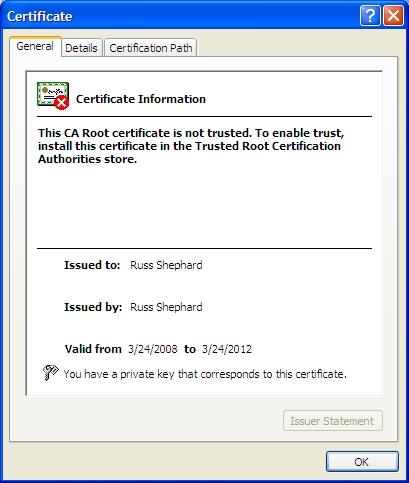
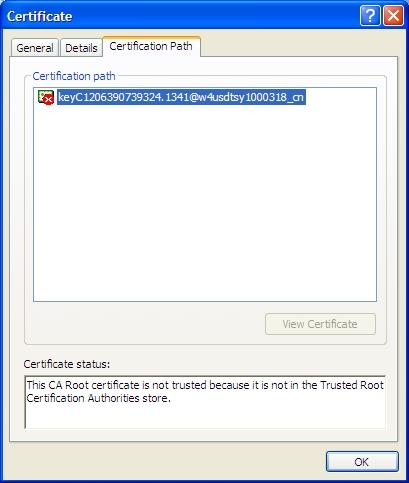
Self-signed certificates are typically used for development purposes as they are easier to create than CA-issued certificates, however your business partners must load the public key for each of your self-signed certificates into their trusted keystore to prevent their applications from throwing errors or warnings. With CA-signed certificates, your business partners only need to load the root certificate for the CA into their keystore and all certificates generated by the CA will be validated.
When self-signed certificates are used as server SSL certificates it may present some issues for your business partners. If they are using an SSL appliance their network security group may not be comfortable installing a self-signed certificate into the appliance’s keystore. This could cause the appliance to reject the SSL sessions.
Self-signed certificates are commonly used for digital signatures or data encryption. Each party will generate a signing or encryption certificate and perform an out-of-band exchange of their public keys using a trusted method to ensure that the source of the certificate is known.
Third-party certificates signed by a well-known CA can always be validated, however they must be purchased, typically on an annual basis
Private CA-signed certificates provide traceability without the cost of third-party certificates, however the root certificate for the CA must be provided to each of your business partners
Self-signed certificates are the simplest to create, making them ideal for development purposes. They are also commonly used for signing or payload encryption. They provide no traceability to a trusted CA, however and they may cause issues with SSL appliances if used as server SSL certificates.
Securing Web Servers and XML Data with SSL. [Fitzpatrick2008]
This section provides guidance for protecting attachments when they are used with SOAP Messages. Note that STAR Conformance all features described in the Basic Security Profile 1.0, including support for attachments and security for attachments in any form by any instance is not required. It is addressed as part of STAR Transport Large File handling mechanism.
Table of Contents
Reliable Messaging can be critical to asynchronous Web Services communication and is REQUIRED as part of the STAR Level 2 Rules. The STAR Web Services specification is based upon the OASIS WS-ReliableMessaging specification v1.1 . This specification provides the foundations for providing enhanced Web Service communication with the following capabilities to assist in guaranteeing delivery: Delivery assurances, Delivery Notification, Conversational integrity, and Failure notification. WS-ReliableMessaging supports all of the STAR Delivery Assurance profiles.
WS-ReliableMessaging has close ties to the WS-Policy framework and recommends the use of WS-Security specifications. WS-Policy can be used with reliable messaging but is currently not a requirement.
WS-Reliable Messaging Version 1.1 was formally adopted by OASIS in June of 2007. Currently, the WS-I Reliable and Secure Profile, is in draft status, and part of the work is based on the new WS-ReliableMessaging 1.2 specification. Some of the Rules for interoperability are based off of profiles from WS-I Reliable and Secure profile. As this profile is updated, STAR will update these requirements. Due to differences in the versions of Reliable Messaging supported by the profile, STAR has modified the rules slighty.
For more information on what Reliable Messaging is, and what is is used for, the InfoQ article by Paul Freemantle, "An Introduction to Web Services Reliable Messaging" [Freemantle2006] is a good starting point. Freemantle covers the basics of WS-ReliableMessaging 1.1, and also reviews the changes that have occured since WS-ReliableMessaging 1.0 was introduced. Several examples in this chapter are based on his article.
As with any specification, there are terms and definitions that should be established. The following terms and definitions are use throughout this chapter.
Endpoint - An entity, processor, or resource that can be referenced where Web service messages are originated or targeted.
Initial Sender - The endpoint which sends a message.
Ultimate Receiver - The endpoint to which a message is delivered.
Delivery Assurance - The guarantee that the messaging infrastructure provides on the delivery of a message.
Source - The endpoint that transmits the message.
Destination - The endpoint that receives the message.
Prefix | Namespace |
soap | http://schemas.xmlsoap.org/soap/envelope/ |
wsa | http://www.w3.org/2005/08/addressing |
| wsam | http://www.w3.org/2007/02/addressing/metadata |
xsd | http://www.w3.org/2001/XMLSchema |
| wsmc | http://docs.oasis-open.org/ws-rx/wsmc/200702 |
wsrm | http://docs.oasis-open.org/ws-rx/wsrm/200702 |
Reliable Messaging is based on a conversation between a client and server. There are many different ways this convesation can take place and all Reliable Messaging frameworks that are being used for STAR implementations should support all of these profiles.
| Reliable Messaging 1.0 Difference |
|---|---|
In Reliable Messaging 1.0 these profiles were built into the protocol. In Reliable Messaging 1.1, these are not sent across the wire, but are configured using policy profiles. It is the responsibility of the framework to guarantee the correct reliablity is being used. |
QName | Delivery Assurance |
AtMostOnce | The messages in the sequence will be delivered to the application without duplication. If a message was to be accidentally delivered more than one time, this ensures that all additional instances of the message are thrown away. It is possible that messages may not be delivered |
AtLeastOnce | The messages in the sequence are assured to be delivered to the application at least once. If a message is delivered more than once, it is not thrown away and is accepted. This could result in a duplicate message. If a message cannot be delivered an error message would be raised. |
ExactlyOnce | The messages in the sequence are assured to be delivered exactly once. This assertion is equivalent to AtMostOnce and AtLeastOnce. In this case the message is guaranteed to be delivered or an error is raised and any messages that arrive more than one time are thrown away. |
InOrder | The messages in the sequence are assured to be delivered to the application in the order they were sent. This is important when multiple messages make up a sequence and the order in which they arrive and or are processed is critical. When this assertion is set, this will ensure that the receiving application will be delivered the messages in the correct order. All messages that are sent within a sequence have a message number, to keep track of the ordering. |
Reliable Messaging is based on a Sequence of events. The various profiles of Reliable Messaging listed below will help determine what the sequence will look like. Sometimes just the client will send a sequence, and other times both client and server may send independent sequence numbers. It is up to the framework implementing Reliable Messaging to keep track of the sequences and acknowledgements where necessary. A general conversation is depicted in Figure 9.1, “Reliable Messaging Conversation Sequence”.
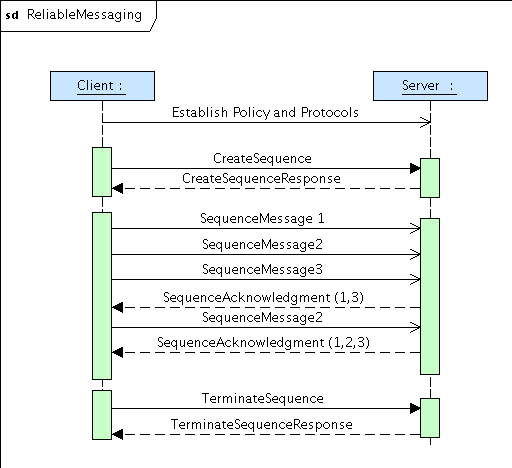
Trading partners may use WS-Policy to estabilish the Assurance Profiles for the Reliable Messaging conversation. In regards to how the messages may look when transmitted, Paul Freemantle's article provides several useful examples.
Example 9.1. Reliable Messaging Create Sequence
<soap:body>
  <wsrm:createsequence>
    <wsrm:acksto>
      <wsa:address>http://Business456.com/serviceA/789</wsa:address>
    </wsrm:acksto>
  </wsrm:createsequence>
</soap:body>
A Reliable Messaging conversation will always start with a
CreateSequence and may be terminated
with a TerminateSequence message. If a
TerminateSequence is not sent, a
framework may use a predefined timeout to automatically terminate the
sequence. In between there can be zero-or-many acknowledgements that
appear in the soap:header. These acknowledgements are in response to the
message sequences that have been received.
Example 9.2. Reliable Messaging Header Acknowledgements
<soap:header>
  <wsrm:sequenceacknowledgement>
    <wsrm:identifier>http://Business456.com/RM/ABC</wsrm:identifier>
    <wsrm:acknowledgementrange lower="1" upper="1" />
    <wsrm:acknowledgementrange lower="3" upper="3" />
  </wsrm:sequenceacknowledgement>
</soap:header>
Each of the above acknowledgement refers to a Sequence Message number that was sent during a conversation.
Example 9.3. Reliable Messaging Header Message Sequence Number
<soap:header>
  <wsrm:sequence>
    <wsrm:identifier>http://Business456.com/RM/ABC</wsrm:identifier>
    <wsrm:messagenumber>1</wsrm:messagenumber>
  </wsrm:sequence>
</soap:header>
The message numbers are usually incremented by one for each of the messages sent. Once the client wants to terminate the conversation with the server, and has sent all of it's sequences, it will send a TerminateSequence message. Once a conversation has been terminated, no more acknowdlegments can occur for that converstation.
Reliable Messaging 1.1 has the ability to establish a reliable delivery system with a server that may not be addressable all the time. During a conversation, a server may set an alternative method to retrieve the rest of the messages. If the conversation is broken, or lost in the middle, the client may try to re-establish the conversation using the MakeConnection protocol. The client will "poll" periodically, to try and establish a connection at the Address specified by the makeconnection element. Once connection is estabilished it will send the request for the message that it needs to receive, and the server will respond back with the message and an indicator if there are any more messages waiting to be sent. [WS-MC2007]
This allows for a server to be off line and for the conversation to be re-established. Some dealerships are still using dial up connections and limited broadband connections that may not always be connected. WS-MakeConnection is the recommended way to continue this conversation and deliver the messages.
MakeConnection may also be used in those situations where a long running process may occur. For example, a client sends a ProcessPartsOrder BOD to a server. Depending on the size and complexity of the PartsOrder BOD it may take a while to process. The server will drop the connection, and the client can try to establish a connection through MakeConnection. If the a response is waiting for the client, it will be sent, otherwise, the server will drop the connection. Eventually the process finishes and the next time the client connects, the message is sent. There may be multiple responses waiting for the client, if so, the server will let the client know about the other messages waiting to be delivered. MakeConnection enables a reliable way of working asynchronously.
WS-ReliableMessage defines general error handling at the SOAP level via SOAP Faults. In the context of STAR Reliable Messaging, WS-ReliableMessaging provides support for Retry (Retransmission), Recovery, TimeOut and Duplicate Detection.
| STAR Level 2 Requirement |
|---|---|
STAR 2010: Error handling is REQUIRED to follow the recommendations of the WS-I Reliable and Secure Profile in regards to handling of errors. |
Retry
WS-ReliableMessaging supports retransmission of unacknowledged messages. As described above, At-Least-Once and Once-Ane-Only-Once / Exactly-Once require the ability to resend messages. WS-ReliableMessaging allows for sending implementations to retransmit messages if an acknowledgement is not received within an agreed upon RetransmissionInterval. The retransmitted message is intended to be exactly the same as the original message and at the very least it must have the exact same Sequence Identifier and MesageNumber.
| STAR Level 2 Requirement |
|---|---|
STAR 2004: If a message was not able to be sent it MUST be retried at least three times. |
Recovery Processes / Message Store
WS-ReliableMessaging does not directly require persistence of messages or specify recovery procedures. STAR requires messages to be persisted to non-volatile storage to be able to function through component, system or network failures and to be able to support duplicate elimination, lookup of messages by Sequence Identifier and Message ID and the ability to retransmit messages.
Time-Out
WS-ReliableMessaging supports the Time-Out feature through a senders ability to specify a Inactivity Time-out and/or BaseRetransmissionInterval policy. The receivers also can specify an AcknolwedgmentInterval through the use of Policy on return messages or through shared policies.
Duplicate Detection
WS-ReliableMessaging specifies that to support At-Most-Once and Exactly-Once Delivery Assurance Profiles, receivers MUST enable message receipt without duplication. Implementation details are not given, but at the very least, a receiver MUST prevent duplicates where Sequence Identifier and MessageNumber are repeated.
The STAR Transport Guidelines establish the overall requirements for Reliable Messaging. To meet these requirements and to ensure that the terminology that is applied correctly maps to comparable Web Services features, follow the specifications below.
Best-Effort
To enable Best-Effort, a message is sent without using any of the WS-ReliableMessaging features:
Parties have no WS-Policies related to reliable messaging for the messages
No WS-ReliableMessaging headers are present in the messages
Only applies to messages without reliability requirements
Best-Effort is the implementation supported by the STAR Level 1 interoperability rules. A STAR Level 2 implementation must support STAR Level 1.
At-Least-Once
To enable At-Least-Once with WS-ReliableMessaging:
Reliable messaging requirements SHOULD be specified with WS-Policy on the message.
| STAR Level 2 Requirement |
|---|---|
STAR 2003: "At-Least-Once" requires the sending party to uniquely identify a message and the receiving party to acknowledge the receipt of the message, giving the sender an auditable record stating that the message has been received. If the sender does not receive an acknowledgment of receipt in a reasonable amount of time (Time-Out), it MUST retry the message send. |
At-Most-Once
To enable At-Most-Once with WS-Reliable Messaging
Reliable messaging requirements SHOULD be specified with WS-Policy.
A durable policy store is required, in memory storage is not sufficient for detecting duplicate messages.
| STAR Level 2 Requirement |
|---|---|
STAR 2005: "At-Most-Once" requires a sending party to uniquely identify messages, to retry failed messages and requires the receiving party to identify and ignore any duplicate messages. In order to know which messages to ignore, it is REQUIRED that the receiving party persist received messages in a durable store. |
Once-And-Only-Once / Exactly Once
To enable Once-And-Only-Once / Exactly Once with WS-Reliable Messaging
Reliable messaging requirements should be specified with WS-Policy.
A durable policy store is required, in memory storage is not sufficient for detecting duplicate messages.
| STAR Level 2 Requirement |
|---|---|
STAR 2006: "Once-And-Only-Once / Exactly-Once" requires the sender to uniquely identify each message and to retry any message that the receiver fails to acknowledge. The receiver must acknowledge receipt of messages and ignore duplicate messages. It is REQUIRED that the receiver persist messages in a durable store to enable duplicate elimination. |
Message Routing
Message Routing in WS-ReliableMessaging is accomplished through a combination of the underlying Transfer protocol and WS-Addressing data elements in the messages themselves. Full behavior is detailed under the WS-Addressing section.
| Note |
|---|---|
Message Routing Most WS-ReliableMessaging v1.1 frameworks have configuration options on how message routing should be handled. In some cases they may also use the WS-MakeConnection specification to handle those situations where an end-point is not always addressable. |
| STAR Level 2 Requirement |
|---|---|
STAR 2007: For indicating Routing information, STAR requires the use of WS-Addressing or WS-MakeConnection if the end point is not directly addressable. |
Acknowledgment of Receipt
Receipt of an acknowledgment indicates that an original message reached its destination. In other words, an acknowledgment signifies only that a message has been received securely and intact, it is not a business level acknowledgment.
| STAR Level 2 Requirement |
|---|---|
STAR 2008: Acknowledgement of Receipts MUST be enabled during the use of At-Most-Once and Once and Only Once reliability. |
WS-ReliableMessaging clearly defines the format and content of Acknowledgment messages. Acknowledgment messages may be stand-alone messages or could be returned as part of another message.
A WS-ReliableMessaging SequenceAcknowledgment is an acknowledgment of receipt of one or more messages associated with a unique sequence. The message contains the exact Sequence Identifier as sent in the original messages and one or more AcknowledgmentRange elements, which specify exactly which messages, by range of MessageNumbers, have been received.
| STAR Level 2 Requirement |
|---|---|
STAR 2009: STAR requires that the messages be sequenced to ensure proper delivery and processing of related messages. |
Content Integrity
WS-ReliableMessaging strongly recommends that messages by secured by WS-Security, specifically that Content Integrity be validate by applying a digital signature to messages. Full behavior is detailed in the Security Section. STAR Level 2 implementations must use Certificate based security when using WS-Reliable Messaging.
TimeToLive
WS-ReliableMessaging implements TimeToLive like functionality via the Sequence Expiration policy assertion or the wsu:expires element on the sequence. This is detailed under the WS-Reliable Messaging specification.
The original STAR Transport Guidelines required that the transports provide the ability to deliver messages reliably. However, theory did not always lead to reality. The state of the WS-ReliableMessaging frameworks at the time did not lead to interoperable or easy to deploy implementations. STAR does not specify when or how to use reliable messaging, that is up to the trading partners. The STAR Level 2 rules on WS-Reliable Messaging only state what needs to be supported to help provide the minimum level of interoperability.
STAR specifies two methods for attachments.
MTOM - Message Transport Optimization Mechanism [MTOM]
SOAP with Attachments - mime-encoded attachments of binary data. [SoapAttachments]
These methods are compatible with each other as the soap envelope, binary data encoding, and HTTP transport are the same. MTOM is supported by newer frameworks, and treats the binary data as if they were just part of the XML data. SOAP with Attachments is the old specification but is still used by many older frameworks. STAR RECOMMENDS that implementations use MTOM as it provides a cleaner programmatic interface for working with attachments. Since attachments are an advanced concept that not every implementation needs, it is considered a STAR Level 2 requirement. Also due to the critical nature of most attachments they need to be Reliable ans Secure so use of WS-ReliableMessaging is required.
The STAR attachment element is defined to allow transporting non-XML data. All internal attachments are encoded as the xsd:base64 data type. External attachments, those that reside on a server, can be communicated using the provided URL identifiers.
| Note |
|---|---|
STAR also recommends the use of the Large File BOD to handle transmittal of files that may normally be too large to provide as an attachment. The Large File BOD allows for the specification of files to be transmitted in chunks and then re-assembled once they are received. |
Binary attachments are to use the MTOM standard or the backwards compatible SOAP with Attachments specification if MTOM is not supported by the tooling framework. The use of DIME attachments is not supported.
| STAR Level 2 Rule |
|---|---|
STAR2013: Attachments MUST use MTOM attachments or SOAP with Attachments. MTOM attachments are RECOMMENDED over SOAP with Attachments. STAR2014: The use of DIME attachments MUST NOT be used. |
MTOM allows an efficient way for binary data to be included in a SOAP envelope with out the need for encoding that data in an XML wrapper. MTOM and SOAP with Attachments make use of the Multipart-Mime encoding mechanism of the HTTP transport to send the data. Frameworks that support MTOM and SOAP with Attachments then can retrieve the attachments via the reference ID.
For these attachments, this element points to the attachment that resides outside the SOAP Envelope.
| Note |
|---|---|
This element is intended primarily to support non-XML data that is not part of a BOD; for example, transactions presented in comma-separated files. BODs that embed non-XML data, such as an image, define their own method of encoding or referencing the binary data. |
The attachment element is an optional element that may appear in the SOAP BODY payload's content section. Implementations may NOT place this attachment elsewhere in the SOAP BODY. The use of the element is to enable the transportation of non-xml formatted data, without the need to encode it into an XML compatible format.
Below is an example of a ProcessMessage request carrying a binary image using the attachment element:
Example 10.1. Sample Message with Attachment
<attachment xmlns="http://www.starstandards.org/webservices/2009/transport">
  <id>token</id> (optional)
  <fileName>fileName</fileName> (optional)
  <attachmentData>#@#$@$@@FADA#$ADFAAFSERWADFVadadfarW</attachmentData> (optional)
  <mimeCode>mimeCode</mimeCode> (required)
  <uriReference>http://tempuri.org</uriReference> (optional)
</attachment>
The STAR Web Services 4.0 template WSDL provided by STAR
includes the necessary definition. The attachment element itself may occur
many times, and is optional.
id - a unique identifier for this attachment. For WS-Attachments implementations this can be the Multipart-Mime Content identifier.
filename - the name of the file to be created.
attachmentData - binary encoded or MTOM/XOP information. MTOM frameworks may replace this with a XOP element that refers to the appropriate Muiltipart-Mime Content identifier.
mimeCode - a mime code that describes the type of content being attached. i.e. application/text, application/xml, image/png, image/jpg
uriReference - a URL where the attachment can be retrieved if it is stored on a server.
The STAR WSDL includes the necessary information to enable frameworks to understand and create the necessary code for MTOM based attachments. This is accomplished by specifying at the XML Schema level the use of the xmime:expectedContentTypes="application/octet-stream".
Example 10.2. WSDL MTOM Encoding
<xsd:element name="attachmentData" type="xsd:base64Binary" xmime:expectedContentTypes="application/octet-stream">
   <xsd:annotation>
     <xsd:documentation source="http://www.starstandard.org">Binary data using base64Binary encoding.</xsd:documentation>
   </xsd:annotation>
</xsd:element>
Use of the content type application/octet-stream allows for the transmittal of any type of binary data. Further information on the specific content type can be specified using the appropriate mimeCode element for the attachment component. A framework that supports MTOM will use the xmime:epectedContentType during code generation from the WSDL to create the appropriate processing instructions. The following example of an MTOM/XOP encoded message comes from the XOP 1.0 specification. [XOP]
Example 10.3. MTOM encoded attachment
MIME-Version: 1.0
Content-Type: Multipart/Related;boundary=MIME_boundary;
    type="application/xop+xml";
    start="<mymessage.xml@example.org>";
    startinfo="application/soap+xml; action=\"ProcessData\""
Content-Description: A SOAP message with my pic and sig in it

--MIME_boundary
Content-Type: application/xop+xml;
    charset=UTF-8;
    type="application/soap+xml; action="ProcessData\""
Content-Transfer-Encoding: 8bit
Content-ID: <mymessage.xml@example.org>

<soap:Envelope
    xmlns:soap='http://www.w3.org/2003/05/soap-envelope'
    xmlns:xmlmime='http://www.w3.org/2004/11/xmlmime'>
  <soap:Body>
    <m:data xmlns:m='http://example.org/stuff'>
      <m:photo xmlmime:contentType='image/png'>
       <xop:Include xmlns:xop='http://www.w3.org/2004/08/xop/include'
          href='cid:http://example.org/me.png'/>
      </m:photo>
      <m:sig xmlmime:contentType='application/pkcs7-signature'>
       <xop:Include xmlns:xop='http://www.w3.org/2004/08/xop/include'
          href='cid:http://example.org/my.hsh'/>
      </m:sig>
    </m:data>
  </soap:Body>
</soap:Envelope>

--MIME_boundary
Content-Type: image/png
Content-Transfer-Encoding: binary
Content-ID: <http://example.org/me.png>

// binary octets for png

--MIME_boundary
Content-Type: application/pkcs7-signature
Content-Transfer-Encoding: binary
Content-ID: <http://example.org/my.hsh>

// binary octets for signature

--MIME_boundary--
A STAR attachments element that was processed by MTOM with a XOP include would look Example 10.4, “STAR MTOM encoded Attachment Element”.
Example 10.4. STAR MTOM encoded Attachment Element
<attachment xmlns="http://www.starstandards.org/webservices/2009/transport">
  <filename>MyAttachment.png</filename>
  <attachmentData>
     <xop:Include xmlns:xop='http://www.w3.org/2004/08/xop/include'
                  href='cid:http://example.org/MyAttachment.png'/>
  </attachmentData>
  <mimeCode>image/png</mimeCode>
</attachment>
The xop:Include href would refer to the Content-ID where the attached data can be retrieved from the Multipart-Mime boundary. The generation of the XOP include is handled by the MTOM framework, and is encoded before the message is sent over the wire by the framework. It is decoded on the receiving end. To the programmer it looks as if it was normal XML encoded data that was sent and received.
Level 1
- STAR1001
All web services must be compliant to the rules and specifications outlined by the WS-I Basic Profile.
- STAR1002
Appropriate compliance markers are required as specified by the WS-I Conformance Claim Attachment Mechanisms document.
- STAR1003
All implementations are required to support Username/Password for authentication.
- STAR1004
All implementations are REQUIRED to send information over HTTPS.
- STAR1005
All passwords are required to be sent as plain text or hashed.
- STAR1008
All services and clients must be compliant to the general Security requirements Outlined by the WS-I Basic Security Profile 1.0 .The optional attributes defined in the Profile is also to be relaxed in the STAR Implementation.
- STAR1009
All STAR Web Services are REQUIRED to understand and handle the STAR Specific SOAP Faults.
- STAR1010
All STAR soap fault error codes are REQUIRED to be be prefixed with STAR: and the appropriate STAR error code. i.e. STAR:Invalid Structure
- STAR1011
All STAR soap fault error codes are REQUIRED to appear in the standard SOAP:Fault block.
- STAR1012
SOAP Faults are for Critical Processing errors only. Informational or warning errors should not be sent as a SOAP Fault.
- STAR1013
ConfirmBOD reason codes that are sent at the Warning or Informational status, SHOULD NOT trigger a resending of the BOD.
- STAR1014
WS-Security errors must send the appropriate WS-Security SOAP Fault for the authorization being used.
- STAR1015
STAR BOD Specific and Generic Transports must be message level interoperable.
- STAR1016
Application level error messages MUST NOT be returned with a SOAP Fault, and MUST be returned using the appropriate BOD.
- STAR1017
The service provider must keep track of contents that are deemed to have been received by the client to avoid resending.
- STAR1018
A SOAP Header MUST contain one manifest element for each content element in the SOAP body.
- STAR1019
A manifest is REQUIRED to have namespaceURI, element, contentID, and version attributes. Even though version is listed as optional it is REQUIRED for STAR BOD and DTS transports.
- STAR1020
The client must be able to handle duplicate messages from a service provider.
Level 2
- STAR2001
Level 2 implementations MUST use X509 certificates.
- STAR2002
Implementations MUST conform to section 12, " X.509 Certificate Token" of the WS-I Basic Security Profile 1.0.
- STAR2003
"At-Least-Once" requires the sending party to uniquely identify a message and the receiving party to acknowledge the receipt of the message, giving the sender an auditable record stating that the message has been received. If the sender does not receive an acknowledgment of receipt in a reasonable amount of time (Time-Out), it MUST retry the message send.
- STAR2004
If a message was not able to be sent it MUST be retried at least three times.
- STAR2005
"At-Most-Once" requires a sending party to uniquely identify messages, to retry failed messages and requires the receiving party to identify and ignore any duplicate messages. In order to know which messages to ignore, it is REQUIRED that the receiving party persist received messages in a durable store.
- STAR2006
"Once-And-Only-Once / Exactly-Once" requires the sender to uniquely identify each message and to retry any message that the receiver fails to acknowledge. The receiver must acknowledge receipt of messages and ignore duplicate messages. It is REQUIRED that the receiver persist messages in a durable store to enable duplicate elimination.
- STAR2007
For indicating Routing information, STAR requires the use of WS-Addressing or WS-MakeConnection if the end point is not directly addressable.
- STAR2008
Acknowledgement of Receipts MUST be enabled during the use of At-Most-Once and Once and Only Once reliability.
- STAR2009
STAR requires that the messages be sequenced to ensure proper delivery and processing of related messages.
- STAR2010
Error handling is REQUIRED to follow the recommendations of the WS-I Reliable and Secure Profile in regards to handling of errors.
- STAR2011
Security in regards to Digital Certificates MUST follow the rules outlined by STAR2002 and the WS-I Reliable and Secure Profile.
- STAR2012
At-Most-Once or Once-And-Only-Once / Exactly-Once implementations must support the handling of duplicate messages.
- STAR2013
Attachments MUST use MTOM attachments or SOAP with Attachments. MTOM attachments are RECOMMENDED over SOAP with Attachments.
- STAR2014
The use of DIME attachments MUST NOT be used.
As specified by the STAR Transport Guidelines, each transport is to have a interoperability check list that is voluntarily filled out by the implementor. This check list should be sent back to STAR either via electronic format or via email submission. The check lists are a way for the STAR to guage the level of adoption as well as what portions of the specification are being implemented. This information is then used as input back to the Architecture Workgroup for further review and action on updates to the transport specification.
This is the STAR Level 1 interoperability check list. Please fill this information out in a spreadsheet, and send back to info@starstandard.org. If the implementation has implemented the rule specified please mark with a Y. If the implementation has not implemented mark with a N. If the rule doesn't apply to your implementation please mark as NA.
Table A.1. STAR Level 1 Check List
| Rule | Description | Implemented (Y, N, NA) |
| STAR1001 | All web services must be compliant to the rules and specifications outlined by the WS-I Basic Profile | |
| STAR1002 | Appropriate compliance markers are required as specified by the WS-I Conformance Claim Attachment Mechanisms document. | |
| STAR1003 | All implementations are required to support Username/Password for authentication | |
| STAR1004 | All implementations are REQUIRED to send information over HTTPS | |
| STAR1005 | All passwords are required to be sent as plain text | |
| STAR1008 | All services and clients must be compliant to the general Security requirements Outlined by the WS-I Basic Security Profile 1.0 .The optional attributes defined in the Profile is also to be relaxed in the STAR Implementation. | |
| STAR1009 | All STAR Web Services are REQUIRED to understand and handle the STAR Specific SOAP Faults. | |
| STAR1010 | All STAR soap fault error codes are REQUIRED to be be prefixed with STAR: and the appropriate STAR error code. i.e. STAR:Invalid Structure | |
| STAR1011 | All STAR soap fault error codes are REQUIRED to appear in the standard SOAP:Fault block. | |
| STAR1012 | SOAP Faults are for Critical Processing errors only. Informational or warning errors should not be sent as a SOAP Fault. | |
| STAR1013 | ConfirmBOD reason codes that are sent at the Warning or Informational status, SHOULD NOT trigger a resending of the BOD. | |
| STAR1014 | WS-Security errors must send the appropriate WS-Security SOAP Fault for the authorization being used. | |
| STAR1015 | STAR BOD Specific and Generic Transports must be message level interoperable. | |
| STAR1016 | Application level error messages MUST NOT be returned with a SOAP Fault, and MUST be returned using the appropriate BOD. | |
| STAR1017 | The service provider must keep track of contents that are deemed to have been received by the client to avoid resending. | |
| STAR1018 | A SOAP Header MUST contain one manifest element for each content element in the SOAP body. | |
| STAR1019 | A manifest is REQUIRED to have namespaceURI, element, contentID, and version attributes. Even though version is listed as optional it is REQUIRED for STAR BOD and DTS transports. | |
| STAR1020 | The client must be able to handle duplicate messages from a service provider. |
[WS-IBP11] WS-I. Basic Profile Version 1.1. 10 Apr. 2006. 7 Jul. 2009.
[WS-IBSP10] WS-I. Basic Security Profile Version 1.0. 30 Mar. 2007. 21 Jul. 2009.
[WS-RM2007] Organization for the Advancement of Structured Information Standards. Web Services Reliable Messaging Version 1.1. WS-ReliableMessaging. 11 Apr. 2007. 28 Oct. 2009.
[WS-RMP2007] Organization for the Advancement of Structured Information Standards. Web Services Reliable Messaging Policy Assertion 1.1. WS-RM Policy. 14 Jun. 2007. 28 Oct. 2009.
[WS-MC2007] Organization for the Advancement of Structured Information Standards. Web Services Make Connection Version 1.0. WS-MakeConnection. 14 Jun. 2007. 28 Oct. 2009.
[WS-Addr2006] W3C. WS-Addressing Core - 1.0. WS-Addressing. 9 May 2006. 28 Oct. 2009.
[WS-AddrSOAP2006] W3C. WS-Addressing SOAP Binding. WS-Addressing SOAP. 9 May 2006. 28 Oct. 2009.
[WS-AddrMetaData2007] W3C. WS-Addressing 1.0 - MetaData. WS-Addressing MetaData. 4 Sep. 2007. 28 Oct. 2009.
[RFC2616.10] W3C. Hypertext Transfer Protocol. HTTP/1.1. Jun. 1999. 29 Oct. 2009.
[ConformanceClaim] WS-I. WS-I Conformance Claim Attachment. 15 Nov. 2004. 29 Oct. 2009.
[ContentTypes] W3C. Describing Media Content of Binary Data in XML. 2 May. 2005. 8 Dec. 2009.
[MTOM] W3C. SOAP Message Transmission Optimization Mechanism. 25 Jan. 2005. 8 Dec. 2009.
[MTOM1.1] W3C. SOAP 1.1 Binding for MTOM 1.0. 05 Apr. 2006. 8 Dec. 2009.
[SoapAttachments] W3C. SOAP with Attachments. 11 Dec. 2000. 8 Dec. 2009.
[XOP] W3C. XML-Binary Optimized Packaging. 25 Jan. 2005. 8 Dec. 2009.
[Fitzpatrick2008] Securing Web Servers and XML Data with SSL. Oct. 2008. Standards for Technology in Automotive Retail. 21 Jul. 2009.
[Tost2005] Loosely typed versus strongly typed Web Services. 02 Sep. 2005. IBM Developer Works. 29 Oct. 2009.
[Butek2005] Tip: xsd:any: A cautionary tale.. 13 Dec. 2005. IBM Developer Works. 29 Oct. 2009.
[Freemantle2006] An Introduction to Web Services Reliable Messaging. 14 Sep. 2006. Infoq. 12 Nov. 2009.